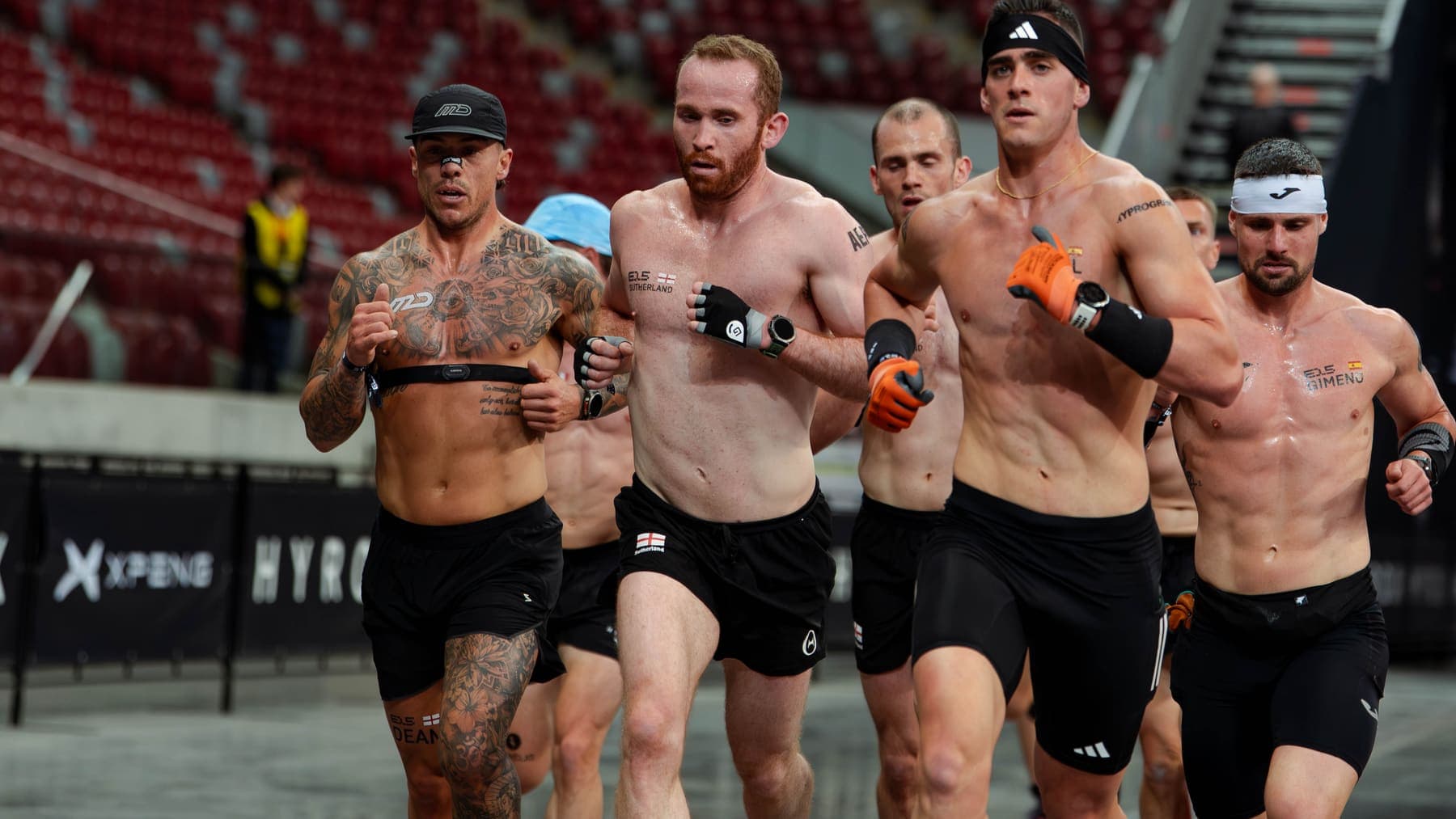
How you split your training week matters more than how many hours you put in. Five hard sessions stacked back-to-back will break you. Four sessions spread with proper recovery will compound for 12 weeks.
The four session types
Every Hyrox training week is built from some combination of:
- Aerobic base. Easy continuous running, cycling, swimming, rowing. 40-90 minutes at conversational pace. Builds the engine.
- Strength. Compound lifts (deadlift, squat, press) plus accessories. 50-60 minutes. Builds the chassis.
- Station-specific work. Sled push, wall ball EMOMs, sandbag lunges. 40-55 minutes. Builds the specific muscular endurance.
- Race simulation. A condensed version of race day. 45-70 minutes. Tests the integration.
A good Hyrox week includes all four. A great Hyrox week orders them so each session sets up the next.
[ BREAKDOWN ]
How much each extra training day buys you
Realistic return on a well-structured week, relative to what a strong four-day week delivers. Coaching judgement, not a measured figure.
- 3 days7/10Enough to finish comfortably. Every session has to earn its place.
- 4 days9/10The sweet spot for most people with jobs. Best return per hour spent.
- 5 days10/10Meaningful gain, but only if recovery and sleep are genuinely handled.
- 6 days10/10No better than five for most athletes, and considerably easier to get injured on.
That flat top end is the point. Going from three days to four is the single biggest upgrade available. Going from five to six mostly buys you fatigue.
The 3-day week
For athletes with limited time. Race-finishable, not race-fast.
| Day | Session | |---|---| | Tue | Strength + 30 min easy run | | Thu | Station-specific (sled + wall ball EMOM) | | Sat | Race simulation OR long aerobic |
Rest days are full rest, not active recovery. Maximises the 3 hard sessions you do have.
The 4-day week (most athletes)
The sweet spot for finishers targeting a strong first race or sub-90.
| Day | Session | |---|---| | Mon | Aerobic intervals (4 × 1 km at race pace) | | Tue | Strength (compound + accessory) | | Thu | Station-specific work | | Sat | Race simulation OR long aerobic (alternate weekly) |
Wednesday is active recovery (mobility, easy walk). Friday is full rest. Sunday is full rest.
The 5-day week
For athletes with a strong endurance base targeting sub-80 or competitive masters categories.
| Day | Session | |---|---| | Mon | Aerobic intervals | | Tue | Strength | | Wed | Easy aerobic 45-60 min | | Thu | Station-specific | | Sat | Race simulation |
Friday active recovery. Sunday off or easy walk.
The 6-day week (advanced)
Only sustainable for athletes who:
- Sleep 8+ hours every night
- Have a stable life (no shift work, no young kids, etc.)
- Are in week 6+ of a planned build
| Day | Session | |---|---| | Mon | Aerobic intervals | | Tue | Strength | | Wed | Easy aerobic | | Thu | Station-specific | | Fri | Skill / technique (sled push pyramid, ski erg pace work) | | Sat | Race simulation |
Sunday off. Mandatory.
The ordering principle
The hardest session should be the most recovered session. That usually means:
- Saturday = race simulation (recovered from Friday off)
- Tuesday = strength (recovered from Monday's quality, or from Sunday off)
- Thursday = station-specific (recovered from Wednesday's easier day)
Avoid putting two demanding sessions back-to-back. Avoid putting race simulation the day before strength. Avoid Friday + Saturday hard combos.
What goes wrong
Three common training-week mistakes:
1. Too many race simulations. One per week. A race simulation is 70-90 minutes of near-race intensity. Two per week and you're under-recovering.
2. Skipping the easy aerobic. Easy aerobic feels too easy to "matter". It's the day that builds the engine. Cut it and your race-pace work gets harder, not easier.
3. Adding extra runs. "I'll just run 5 km on Wednesday for fun." That 5 km is now Wednesday's training session and you under-recover for Thursday. Hyrox builds use 3-4 runs per week, no more.
Mixing it with life
Most athletes can't train at exactly the same time every day. Two principles to make it work:
- Protect the hardest sessions. The race simulation and the strength session get priority on the calendar.
- Move sessions, don't skip them. A Tuesday session moved to Wednesday is fine. A skipped Tuesday is a lost adaptation.
If you have a busy week and have to drop a session, drop one of the easy ones (Wednesday aerobic, Friday skill). Keep the hard ones.
Weekly load distribution
Across the week, the cumulative training load should look something like:
| Day | Load | |---|---| | Mon | 70% | | Tue | 80% | | Wed | 30% | | Thu | 70% | | Fri | 20% | | Sat | 90% | | Sun | 0% |
That distribution gives the body a chance to absorb hard sessions before the next one. Stacking 90% days back-to-back is how injuries happen.
The build phases
A 12-week Hyrox build typically structures the weeks differently:
- Weeks 1-4 (base): 3-4 day weeks. Heavy on aerobic base. Light on intensity.
- Weeks 5-8 (build): 4-5 day weeks. Add intensity. Add race-specific.
- Weeks 9-11 (peak): 5-6 day weeks. Highest intensity. Race simulations weekly.
- Week 12 (taper): 3-4 day week. Cut volume 40-60%. Keep intensity sharp.
The week structure changes as the build progresses. Don't try to start at 6 days; build into it.
The honest summary
The right training week depends on your goal, your recovery capacity, and your life. Most athletes thrive on a 4-day week with proper rest days. Trying to train 6 days when your sleep won't support it is the fastest way to under-recover.
Pick the week that you can sustain for 12 weeks. Adjust based on how you feel in week 4. The athletes who race well are the ones whose training week is sustainable, not heroic.
Related
[ FAQ ]
Frequently asked
How many days should I train per week for Hyrox?
4 days is the sweet spot for most athletes. 3 is enough for a base-build phase. 5-6 is for athletes targeting a fast time who have time to recover. Most over-train at 5+ because their sleep doesn't match.
Should I run every day?
No. 3-4 runs per week is enough for Hyrox. The race is 8 km of running; you don't need 50 km weekly. Quality over quantity.
When should I do my race simulation?
Saturday is the most common day. Allows Sunday for full recovery before Monday's work. Race simulations are demanding and should be the only hard session that day.
Can I do Hyrox training and CrossFit at the same time?
Briefly, but you'll have to sacrifice quality on one. Hyrox training is specific. CrossFit's metcons aren't bad for you but they compete for the same recovery.

Written by
The Suth Performance teamCoaches and editors
The Suth Performance programming team, led by HYROX Elite 15 athlete Ben Sutherland. They write the training, technique and race-day guides on this site, and Ben reviews every one before it is published.
[ KEEP READING ]
Related guides

Training
How many times a week should you train?
Three is the honest answer for most people, and four is where the returns start flattening. Why more is usually worse, and the frequency that beats all of it.

Training
Strength training for beginners: the five movements
Squat, hinge, push, pull, carry. Everything else is a variation. How to start, how to progress, and why the programme was never the hard part.

Training
1-on-1 personal training vs group sessions: choosing honestly
One is not better than the other. They solve different problems, and picking wrong is the most common reason people stop paying for coaching within three months.