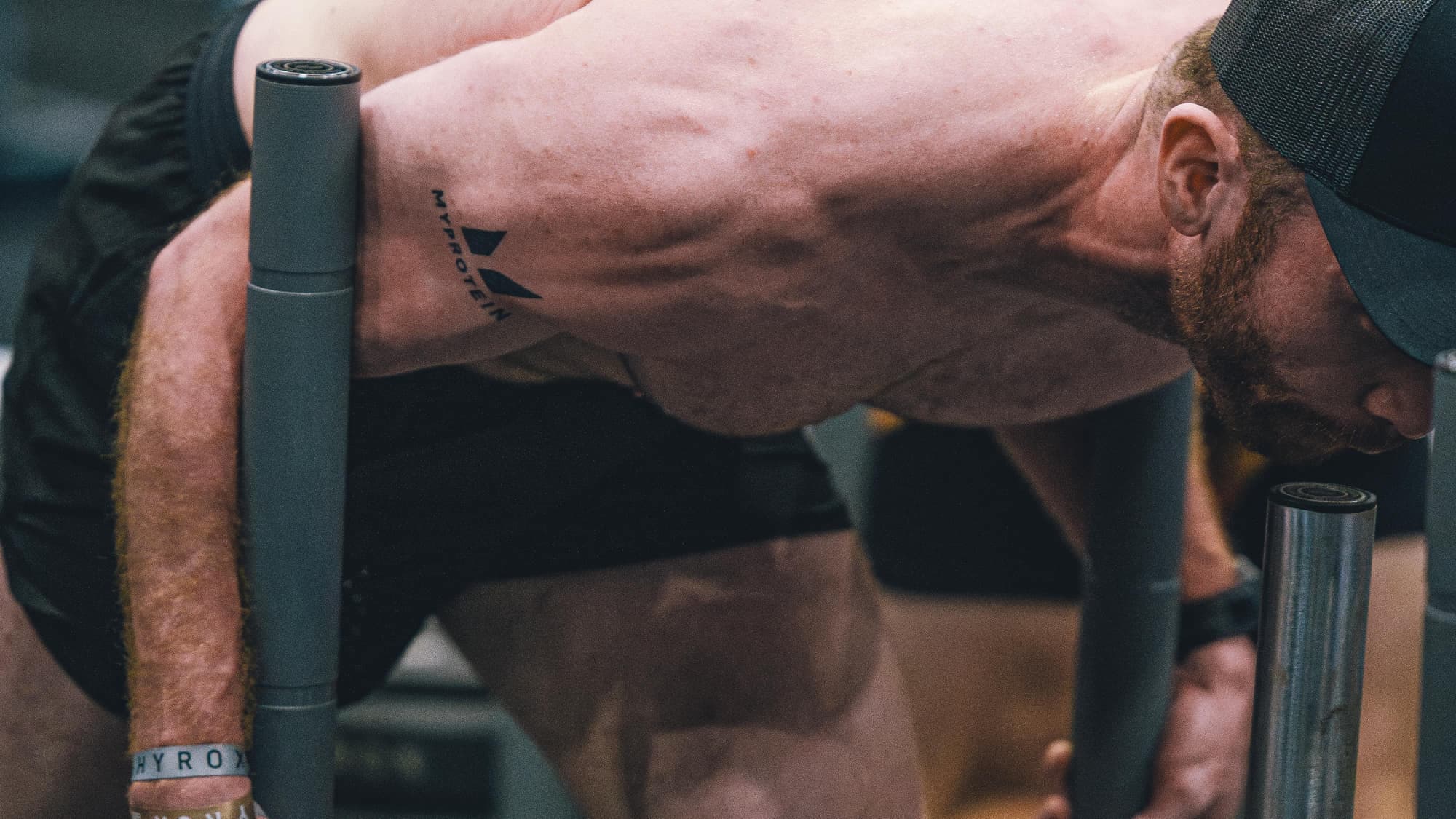
These are five complete sessions rather than a list of drills, and they are ordered so you can run them as a block. Two sled sessions a week is plenty alongside your running.
Before any of them: weigh your gym's sled. Official loads include the sled itself, so 152kg means 152kg total, not 152kg of plate on top. Getting this wrong is the most common reason people believe the sled push is impossible.
Why trust this
Loads and the station standard come from the official 26/27 singles rulebook. Ben Sutherland races Pro Doubles on the Elite 15 start list at the 202kg standard.
1. Position, at low intensity
The one everybody skips and the one that pays fastest.
- Warm-up: 10 minutes easy, then 2 x 12.5m at half race weight.
- Work: 6 x 12.5m at race weight, walking back, full recovery between efforts. This is not conditioning.
- Focus: long body line from hands to heels, arms locked, short choppy steps, eyes down.
- Stop when: your position breaks. Quality only.
You are learning a shape, not building fitness. If you can only hold it for four reps, do four.
2. Extended repeats
Holding position while breathing hard.
- Warm-up: as above.
- Work: 5 x 25m at race weight, 90 seconds rest.
- Focus: the second half of each rep, where position degrades first.
- Progression: same session next week with 75 seconds rest.
3. Full station, timed
The benchmark.
- Work: 4 x 50m (four lengths of 12.5m) at race weight, 2 minutes rest.
- Record: the time for each of the four.
- What it tells you: if rep four is more than 25% slower than rep one, your limiter is endurance rather than strength. If they are all slow and even, it is strength.
Repeat monthly. It is the cleanest measure of progress on this station.
4. The compromised push
The session that actually transfers.
- Work: 3 rounds of: 1km run at goal race pace, then 50m sled push at race weight, then 90 seconds walking.
- Why: pushing a sled fresh has very little to do with pushing one at kilometre two with your heart rate at 170.
- Expect: it to feel dramatically harder than session three. That gap is the thing you are training.
If you do one session on this page, do this one.
5. Strength carryover
For the underlying engine, on a non-sled day.
- Heavy sled-adjacent: 4 x 20m heavy prowler or weighted march, heavier than race weight, full recovery.
- Then: 4 x 6 rear-foot elevated split squats each leg, 4 x 8 Romanian deadlifts.
- Finish: 3 x 40m hill sprints if you have a hill.
Squats and hinges build the capacity. The sled sessions turn it into a faster station.
If you cannot move race weight
This is common and it is not a reason to avoid the station.
- Find the heaviest load you can push continuously for 12.5m without stopping.
- Work at that for two sessions a week.
- Add roughly 10kg a week.
- Re-test the full 50m monthly.
Never grind at a load that stops you every three metres. It teaches a broken position and rehearses failure.
Putting it into a week
| Day | Session | |---|---| | Mon | Strength carryover (5) | | Tue | Threshold run | | Wed | Rest or easy | | Thu | Compromised push (4), or position work (1) early in a block | | Fri | Strength | | Sat | Long easy run | | Sun | Rest |
Rotate sessions 1, 2 and 3 through the Thursday slot in the early weeks, then move to session 4 as the race approaches.
Honest limitations
Sled friction varies noticeably between venues with the floor surface, so your gym times will not map exactly onto race day.
And the honest proportion: for most athletes the sled push is not what stands between them and a better finish. Running is. Two sled sessions a week is a sensible ceiling, not a target to exceed.
If you have a lower back history, get the position checked by a professional before adding load.
Next step
For the technique faults these sessions correct, see sled push mistakes.
The fitness assessment quiz will tell you whether the sled is genuinely your limiter.
Source: loads and station standard from the official HYROX singles rulebook, season 26/27.
Related
[ FAQ ]
Frequently asked
How do you train for the HYROX sled push?
Push at actual race weight, in short repeats, twice a week, and at least one session a week straight off a 1km run. Weigh your gym sled first, because the official figures include the sled itself.
What if I cannot push race weight?
Drop to a load you can move continuously for 12.5m and add roughly 10kg a week. Grinding at a weight that stops you every three metres only rehearses failure.
Does squatting help the sled push?
Some, but less than people expect. The sled push is horizontal force production and a specific body position. Heavy squats build the engine; only pushing builds the skill.

Written by
The Suth Performance teamCoaches and editors
The Suth Performance programming team, led by HYROX Elite 15 athlete Ben Sutherland. They write the training, technique and race-day guides on this site, and Ben reviews every one before it is published.
[ KEEP READING ]
Related guides

Training
5 workouts that build a faster HYROX burpee broad jump
The station that spikes heart rate harder than anything else, immediately before the one place you can recover. Five sessions for rhythm, legal form and recovery control.

Training
5 workouts that build a faster HYROX row
The only station where going slower can make you faster. Five sessions for sequencing, split discipline, and using the row as the recovery it was positioned to be.

Training
5 workouts that build faster HYROX sandbag lunges
Station seven, on quads that are already gone. Five sessions built on exposure rather than load, because the bag is not what makes this hard.