The sled push ends more first HYROX races than any other station, and it usually does it without appearing to. The split looks acceptable. The damage shows up on runs four, five and six, when your legs have nothing left.
Four faults account for most of the time lost, and one of them happens weeks before race day.
Why trust this
Loads and the station standard are read from the official 26/27 singles rulebook. Ben Sutherland races Pro Doubles on the Elite 15 start list at the 202kg standard.
The standard, exactly
50 metres, run as four lengths of 12.5m. Weights are 102kg Women's Open, 152kg Men's Open and Women's Pro, 202kg Men's Pro, and every one of those figures includes the sled itself.
The rules that carry penalties:
- You must use the lane assigned to you by the judging team.
- Both sled and racer must be completely behind the white line before starting.
- Both must stay in your lane and not interfere with a neighbouring one.
- The sled must pass the 12.5m mark entirely before you change direction.
Standard escalation: warning, then 15 seconds, then a further 15 seconds each time.
The four mistakes
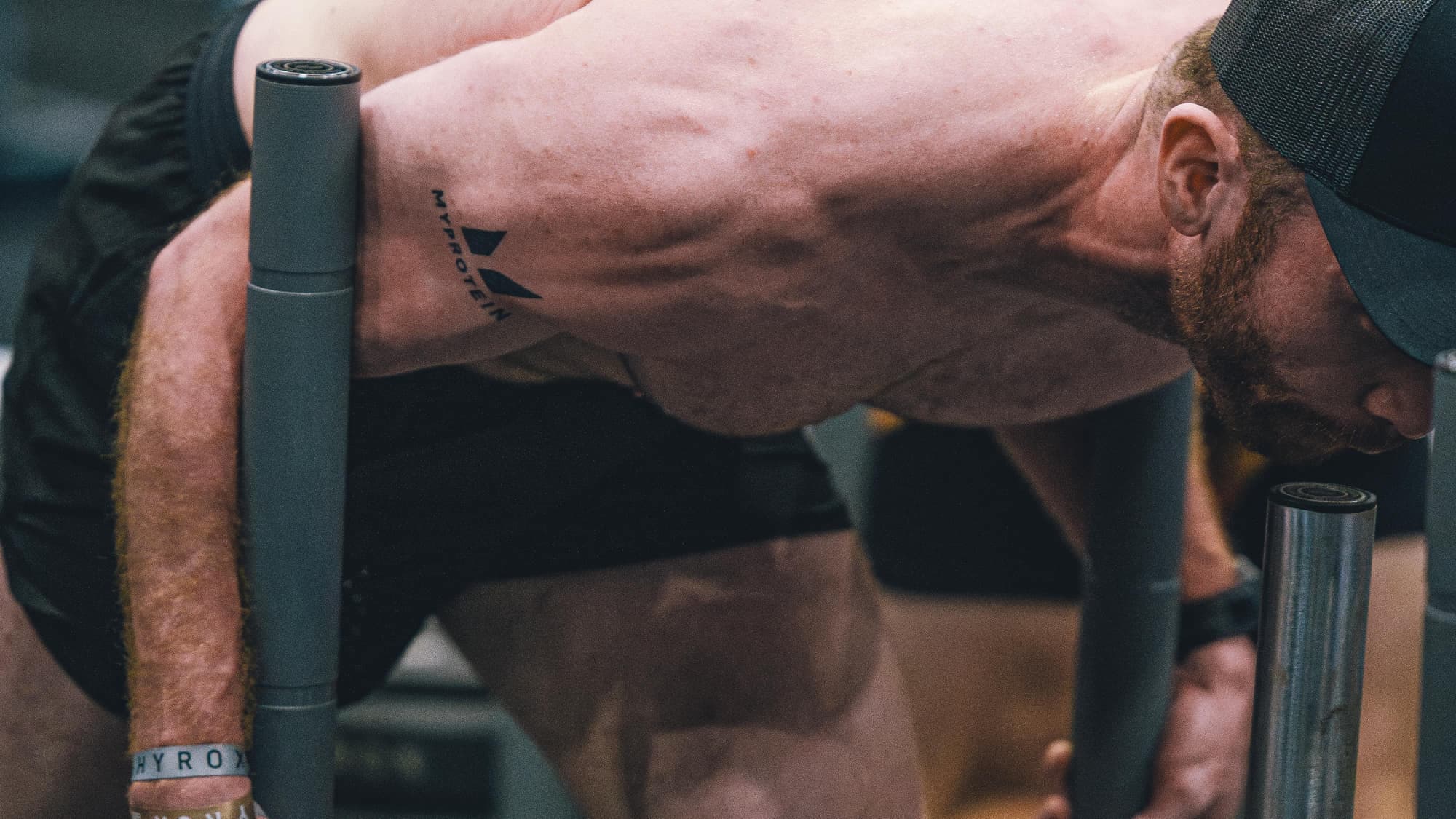
1. Standing too upright. The single biggest technical fault. Upright means you are pushing down into the floor rather than driving the sled horizontally. Every degree of unnecessary height converts drive into friction.
The fix: get low. You want a long body angle, close to a straight line from hands through hips to heels. It should feel uncomfortably low.
2. Bent arms. Soft elbows turn the push into a partial press and absorb force that should be reaching the sled. It also fatigues your shoulders for no return.
The fix: lock the arms out and let your legs do the work. Your arms are struts, not engines.
3. Long strides. A long stride includes a moment where neither foot is driving, and the sled decelerates in that gap. Restarting a stopped sled costs far more than keeping a slow one moving.
The fix: short, choppy, continuous steps. It looks less athletic and it moves the sled faster.
4. No break plan. Athletes decide how to break the station after they have failed, which is the worst possible moment to make a decision at 180bpm.
The fix: decide before you touch it. Four lengths of 12.5m gives four natural stopping points. Commit to one, two or four segments in advance and follow the plan even if the first length feels easy.
The training error that causes all of this
Sled weights include the sled. Your gym sled weighs somewhere between roughly 20kg and 60kg empty. Load 152kg of plate onto a 45kg sled and you are pushing 197kg, within touching distance of Men's Pro.
Athletes who train that way conclude the sled push is impossible, grind every session, never develop a repeatable position, and arrive at a race having prepared for a station that does not exist.
Find out what your gym's sled weighs, write it in your phone, and load to race weight minus sled weight from now on. If nobody knows, assume 40kg and note that your training is approximate.
The faults at a glance
| Fault | Costs you | Fix | |---|---|---| | Standing too upright | Drive converted to friction | Long body line, hands to heels | | Bent arms | Force absorbed before the sled | Lock out, legs do the work | | Long strides | Sled decelerates between steps | Short, choppy, continuous | | No break plan | A 90s station becomes 3 minutes | Decide segments before you start | | Training at plate weight | A whole block prepping the wrong load | Weigh the sled, subtract it |
The practical part: a four-week block
Twice a week alongside your normal running.
- Week 1: 6 x 12.5m at race weight, full recovery. Position only. You are learning a shape.
- Week 2: 5 x 25m at race weight, 90 seconds rest. Holding position while breathing hard.
- Week 3: 4 x 50m at race weight, 2 minutes rest. Full station distance, timed.
- Week 4: 3 x (1km run, then 50m sled). The one that counts. Pushing fresh has little to do with pushing at race pace off a kilometre.
If you cannot move race weight at all, drop to a load you can push continuously for 12.5m and add roughly 10kg a week. Grinding at a weight that stops you every three metres only rehearses failure.
Honest limitations
Sled friction varies noticeably between venues with the floor surface, so the same 152kg genuinely is harder in some halls. You can train position, pacing and breaks. You cannot train the floor you will get.
The sled is also rarely the thing standing between you and a better finish. Running is. It just feels more dramatic.
If you have a lower back history, this station deserves professional guidance rather than enthusiasm.
Next step
For the full weight table by division, see sled push weights.
The fitness assessment quiz will tell you whether the sled is genuinely your limiter.
Source: loads, lane rules and penalty protocol from the official HYROX singles rulebook, season 26/27.
Related
[ FAQ ]
Frequently asked
Why is the HYROX sled push so hard?
Because it arrives at station two after only 2km of running, when adrenaline hides your true effort, and because most people push it in a position that leaks force. It is 102kg, 152kg or 202kg including the sled, over 50m in four 12.5m lengths.
What is the correct sled push technique?
Low body angle close to a straight line from hands to heels, arms locked out, short choppy steps, head neutral. You are driving horizontally into the floor, not pushing downward.
How do you break up the HYROX sled push?
Decide before you start. The 50m is four lengths of 12.5m, which gives natural stopping points. Planning one, two or four segments in advance beats stopping when you fail.

Written by
The Suth Performance teamCoaches and editors
The Suth Performance programming team, led by HYROX Elite 15 athlete Ben Sutherland. They write the training, technique and race-day guides on this site, and Ben reviews every one before it is published.
[ KEEP READING ]
Related guides

Technique
Burpee broad jump mistakes: what's costing you 60 seconds
There is no minimum jump distance, which changes the whole strategy. Five faults, the 5cm rule almost nobody knows, and why long jumps are usually the wrong answer.

Technique
Farmers carry mistakes: what's costing you 60 seconds
Putting the bells down is the obvious mistake. The expensive ones are training grip fresh, not counting your laps, and losing the box on the way back in.
Technique
HYROX sled push weight: standards by division (and how it feels)
102kg, 152kg or 202kg, and every one of those figures includes the sled. The most misunderstood number in HYROX, and the station that ends more first races than any other.