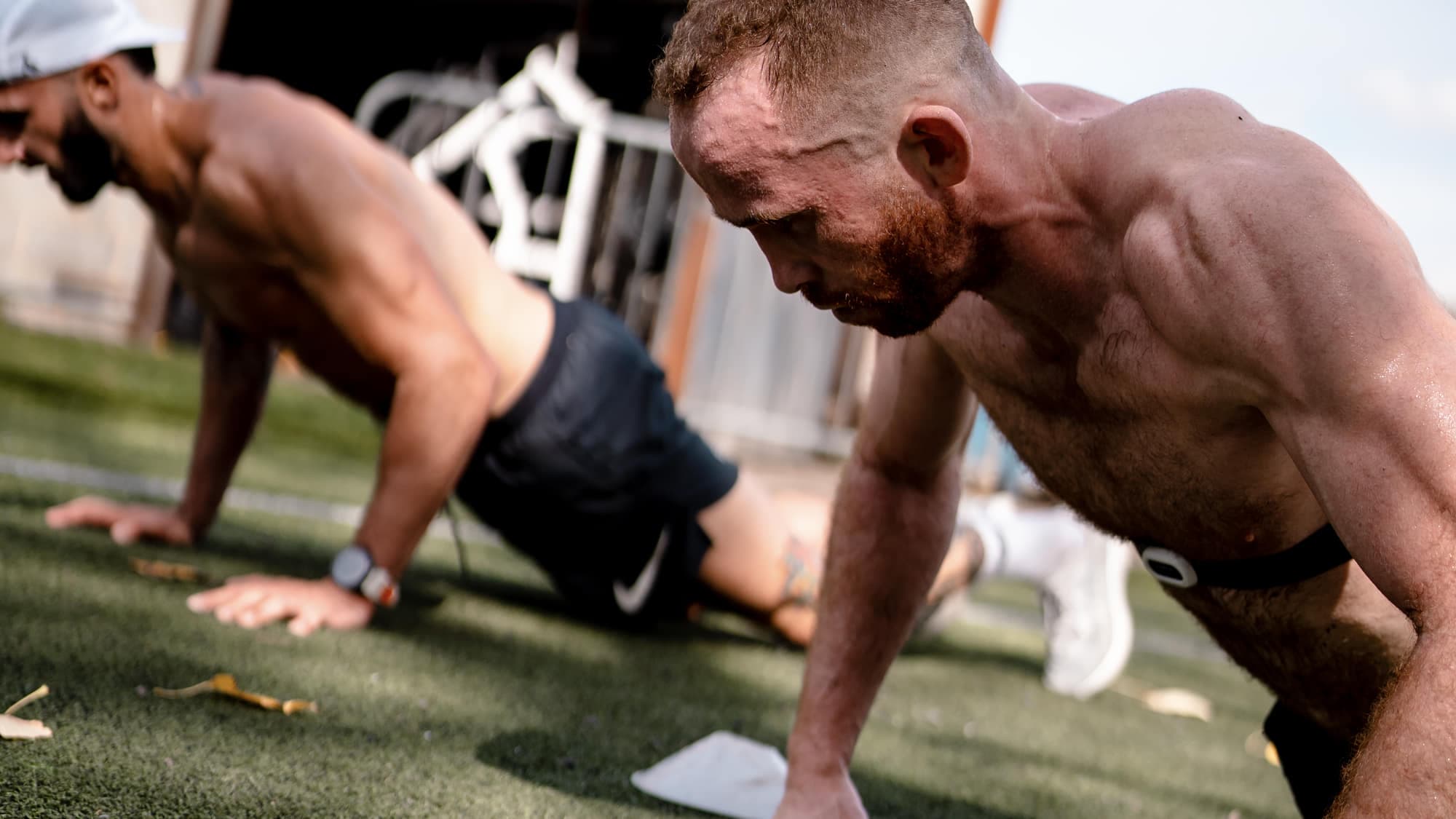
Doubles makes Hyrox accessible to athletes who'd find solo intimidating. Two friends, a shared race plan, half the work per person. Get the strategy right and a doubles pair can finish faster than the slower partner's solo time. Get it wrong and the pair finishes slower than the slower partner could have alone.
The split-station framework
Each station has options. Here's the strategy most fast doubles pairs use:
| Station | Recommended split | |---|---| | Ski erg | 500 m each. One works, one rests. | | Sled push | Both push together (the load is the same for one or two). | | Sled pull | Both pull together for the same reason. | | Burpee broad jump | 40 m each. Tag at metre 40. | | Rower | 500 m each. One works, one rests. | | Farmer's carry | 100 m each. Tag at metre 100. | | Sandbag lunges | 50 m each. Tag at metre 50. | | Wall ball | 50/50 reps. Tag every 25 reps (2-3 sets each). |
This is the default. Variations exist; this is the most common fast-team approach.
Handoff technique
The handoff is where 30-90 seconds of doubles time is found or lost.
The fast technique:
- Athlete A finishes the segment.
- Steps clear of the equipment in one motion.
- Tags Athlete B with a clear contact (hand to hand).
- Athlete B is already pre-positioned beside the equipment.
- Athlete B starts the next segment in one motion.
Total handoff time: 1-3 seconds. Athletes who handoff in 1 second look choreographed.
The slow technique:
- Athlete A finishes the segment.
- Steps back, stretches, talks.
- Athlete B walks over, picks up the equipment.
- Starts the segment.
Total handoff time: 8-15 seconds. Over 8 stations that's 60-120 seconds.
The pre-position rule
The single most-important doubles rule: the non-working athlete is always 1-2 metres from where the working athlete will tag them. Not standing in the corner. Not stretching. Not chatting.
This applies to all split stations. The pre-position changes the handoff from "wait for partner to come find me" to "tag and go".
Pacing for the pair
Pace at the slower partner's sustainable rate. Always.
This is hard for the faster partner. The instinct is to push the pace, hoping the slower partner will rise. They won't. They'll blow up by station 5 and the pair will lose more time in the back half than they gained in the front.
The right strategy:
- Stations 1-3: Match the slower partner's controlled pace.
- Stations 4-6: Same pace. The faster partner is the energy manager.
- Stations 7-8: If the slower partner is holding up well, the faster partner can pull slightly. If they're struggling, hold the pace.
- Last 1 km run: If anything is left in the tank, this is when it comes out.
The run pace
Both partners run every 1 km. The run pace is the slower partner's sustainable pace, with the faster partner running alongside.
The faster partner has a useful role: pace-setter and breath-counter. Talk less. Match stride. Keep the slower partner in rhythm.
If the faster partner runs ahead, the pair loses time at the next station because the slower partner arrived more tired than necessary.
Station-specific tactics
Ski erg + rower (500 m each)
These are the only stations with built-in rest. Use it.
- Athlete A's 500 m: Athlete B walks 5 m away to a designated spot, takes 60 seconds of deliberate deep breathing.
- Tag at 500 m: Athlete B steps in cleanly.
- Athlete B's 500 m: Athlete A does the same recovery sequence.
The rest is short but it matters. Athletes who use the rest properly arrive at station 2 fresher.
Sled push + sled pull (both work together)
No rest possible. Both push or pull. The strategy:
- Match pace. One partner naturally pushes harder; the other should match, not exceed.
- Communicate. "Two more metres" or "halfway" out loud helps both stay synchronised.
- Recovery breath together. After the station, walk to the run lane in step, breathing together.
Burpee broad jump (40 m each)
The tag spot is metre 40. The non-working athlete is pre-positioned at metre 40, ready to start.
Athlete A jumps to metre 40, lands, taps Athlete B's hand. Athlete B starts jumping immediately. Athlete A walks past Athlete B's track to the rest zone.
Farmer's carry (100 m each)
Athlete A picks up the bells, carries 100 m, places them at the tag line. Athlete B picks them up and carries the second 100 m back. The handoff is the placement; no hand-tag needed but smooth motion matters.
Sandbag lunges (50 m each)
The same as farmer's carry: athlete A lunges 50 m, drops the bag at the tag line, athlete B shoulders it and lunges the second 50 m. Drop the bag carefully; don't fumble.
Wall ball (50/50 split)
The most variable station. Options:
- 2 sets of 25 each. Easier for less-fit pairs. More handoffs.
- 2 sets of 50 each. Harder, fewer handoffs, slightly faster.
- 5 sets of 10 each (rotation). For pairs with very different wall ball fitness.
Pick before the race. Don't decide mid-station.
Pairing different fitness levels
If one partner is significantly fitter than the other (say 90-minute solo vs 110-minute solo):
- Stronger partner takes more reps. 60/40 split on wall ball, more lunges, etc.
- Stronger partner does both ski erg and rower segments at higher intensity. Pulls the team's average up.
- Weaker partner focuses on holding their share at sustainable pace. Don't try to match the stronger partner's intensity.
The team's time will be closer to the slower partner's solo time than the average. Manage expectations.
Training as a pair
If you're racing doubles, train at least 3 sessions per week together in the 6 weeks before the race.
- Session 1: handoff drills. 30 minutes of station-to-station tagging. Practice each handoff 10 times.
- Session 2: pace matching. 8 km run at the slower partner's pace. The faster partner stays at the same speed.
- Session 3: full race simulation. Once per week. 60-70 minutes of stations + runs in race format.
Doubles pairs who don't train together race poorly together. The synchronisation is a learned skill.
The honest summary
Doubles can be faster than solo when the strategy is right. The handoffs, pre-positioning, and partner pacing decide more about race-day than individual fitness.
Pick a partner within 10% of your sustainable pace. Practice the handoffs until they're 1-2 seconds each. Pace at the slower partner's sustainable rate. Communicate.
The pairs who race well are the ones who treat doubles as a different sport, not as a 50%-off solo. Train it as a team and race it as a team.
Related
Next step
Handovers only pay off once both of you are fit enough to hold the pace between them. The doubles training plan is built for two athletes who are not the same athlete.
Start with the fitness assessment quiz so the split is based on real numbers rather than who feels stronger.
[ FAQ ]
Frequently asked
Should both partners run the 1 km?
Yes. Both run every 1 km. The stations are split; the runs are not.
How do you split the wall ball?
100 reps for open. Most pairs split 50/50 in 2-3 sets each. The format: athlete A does 25, tags athlete B who does 25, repeat once. Some advanced pairs do 50/50 in one set each.
Can one partner do a whole station while the other rests?
Yes for distance-based stations (ski erg, rower, sandbag lunge, farmer's carry, burpee broad jump). One partner can complete the full distance. Faster pairs split for rest distribution.
What if the partners are different speeds?
Race at the slower partner's sustainable pace. Trying to pull a slower partner up wrecks both. Pair athletes within 5-10% of each other's solo pace for best results.
Written by
The Suth Performance teamCoaches and editors
The Suth Performance programming team, led by HYROX Elite 15 athlete Ben Sutherland. They write the training, technique and race-day guides on this site, and Ben reviews every one before it is published.
[ KEEP READING ]
Related guides

Training
Hyrox doubles: the strategy of two athletes, one clock
Doubles isn't half a Hyrox per athlete. It's a different race, pace decisions, handoff strategy, and station splits that share weaknesses without amplifying them. The complete framework.

Training
15 HYROX workouts for every fitness level
Fifteen sessions you can do this week, grouped by whether you are starting out, building, or sharpening for a race. Most need nothing more than a treadmill and a couple of kettlebells.
Training
5 workouts that build a faster HYROX burpee broad jump
The station that spikes heart rate harder than anything else, immediately before the one place you can recover. Five sessions for rhythm, legal form and recovery control.