The most useful HYROX session is not the one that leaves you on the floor. It is the one that teaches you to run on legs that have just done something else. Almost every workout below is built around that single idea.
Fifteen sessions, grouped by where you are. Take one or two a week, not all of them.
Why trust this
Sessions are built around the actual race demands set out in the official 26/27 rulebook: 8km of running split into eight 1km efforts, each after a station. Ben Sutherland races Pro Doubles on the Elite 15 start list, so the structure reflects how the race is actually raced.
Starting out
You can complete a HYROX. These build the base and teach the pattern.
1. The introduction. 4 rounds: run 400m, 20 wall balls (or 20 goblet squats), walk 60 seconds. This is the whole race in miniature and it needs almost no kit.
2. Easy aerobic run. 30 to 40 minutes at a pace where you could hold a conversation. Boring, and the single highest-return thing on this page.
3. Lunge tolerance. 5 rounds: 20m walking lunges holding a moderate weight, 200m easy jog. The lunges land at station seven when your quads are gone, and tolerance is built by exposure.
4. Erg intervals. 5 x 500m on a rower, 90 seconds rest. Learn to pace an erg before you have to do it at kilometre five.
5. Full-body strength. Goblet squat, Romanian deadlift, press, row, farmers carry. 3 sets of 8 to 10 each. Twice a week, forever.
Building
You have a base and a race booked. These add the specific demands.
6. Compromised running. 4 rounds: 500m row hard, then 1km run at goal pace. This is the closest thing to the actual race on this list. If you do one session a week, do this one.
7. Sled repeats. 6 x 50m sled push at race weight, 2 minutes rest. Weigh your gym's sled first, because rulebook weights include the sled.
8. Wall ball volume. 100 reps for time, broken however you like, at race weight to race target height. Record the time. Repeat monthly.
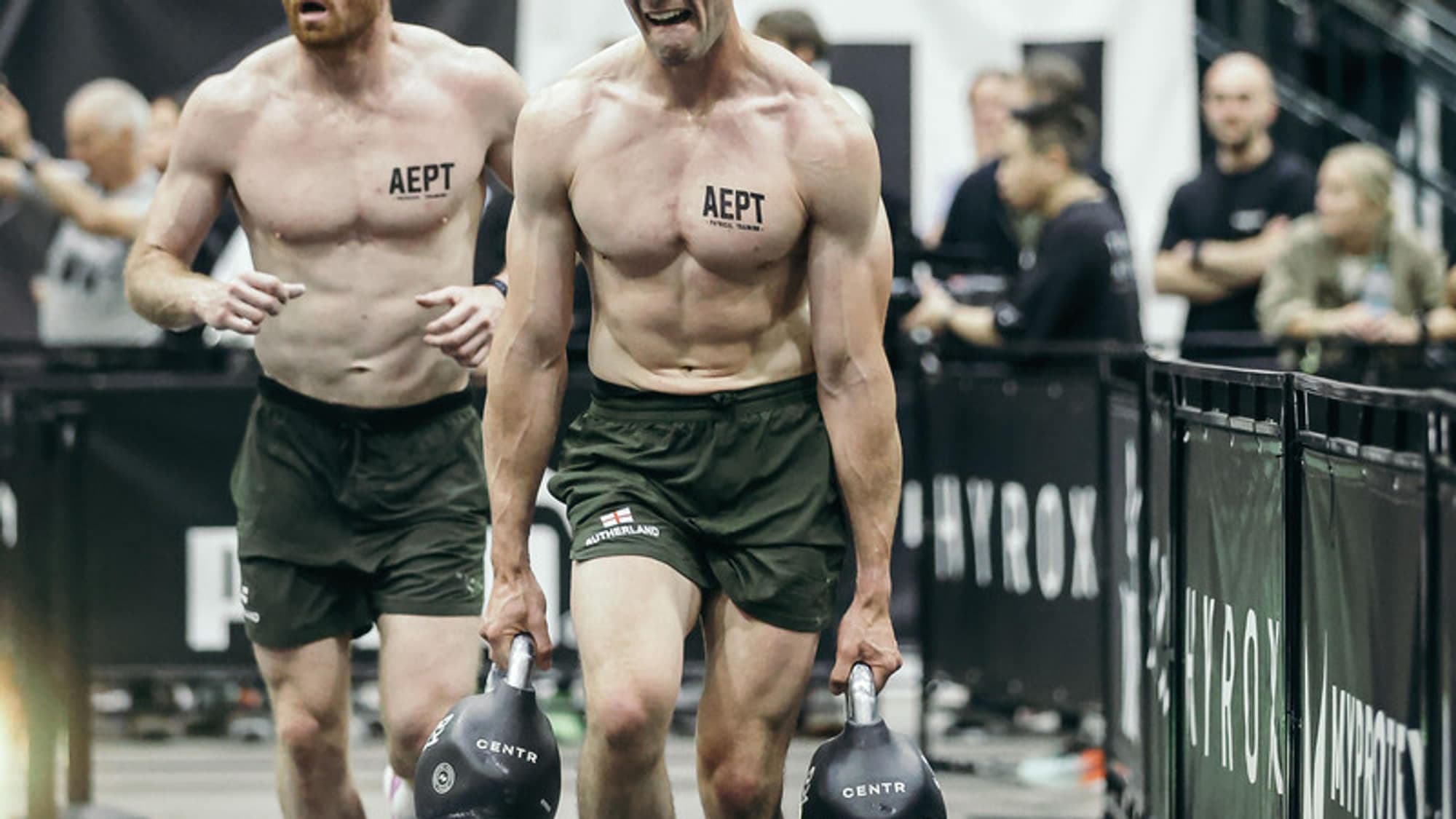
9. Grip circuit. 3 rounds: 200m farmers carry, 10 hand-over-hand rope pulls or heavy lat pulldowns, 60 seconds rest. Grip fails at two separate stations and nobody trains it.
10. Threshold run. 5 x 1km at a hard but repeatable pace, 90 seconds jog between. Builds the engine the running actually needs.
11. Burpee broad jump ladder. 5 rounds: 20m burpee broad jumps, 200m run. Keep the jumps short and the landings clean, since there is no minimum jump distance but there is a 5cm foot-stagger rule.
Race sharpening
Six weeks out or closer.
12. Half simulation. 4 x (1km run + one station), using the first four stations in order. Full race weights. This is where you find out what your pacing plan is actually worth.
13. Back half. 4 x (1km run + one station) using stations five to eight, starting already tired from a 3km run. The back half is where races are lost.
14. Full simulation. The whole thing, once, four to six weeks out. Not closer, because recovery from a full simulation takes a week. Do it at race weight, with realistic transitions.
15. Transition drill. 8 rounds: 200m run, 30 seconds of any station movement, out and running within 10 seconds. Roxzone time counts towards your finish and almost nobody rehearses it. Cheapest time on this page.
The practical part: putting them into a week
You do not need all fifteen. A workable week for most people building towards a race:
- Monday: strength (5)
- Tuesday: threshold run (10)
- Wednesday: rest or easy walk
- Thursday: compromised running (6) or a station session (7, 8, 9)
- Friday: strength (5)
- Saturday: long easy run (2)
- Sunday: rest
Three runs, two strength sessions, one HYROX-specific session. Add a simulation (12, 13, 14) in place of Thursday's session as the race approaches.
Substitutes, if your gym is missing kit
| Missing | Use instead | |---|---| | Sled | Hill sprints, heavy weighted march, or a prowler | | SkiErg | Rower plus lat pulldowns | | Sandbag | Heavy backpack, or a barbell in the front rack | | Wall ball | Goblet squat to a press, or a med ball to any high target | | Rope for sled pull | Seated cable rows, heavy, short rest |
Substitutes get you most of the way. The one worth going out of your way for is the sled, because body position under load is genuinely specific and hard to approximate.
Honest limitations
These are sessions, not a programme. Sequencing them across twelve weeks, with the right progression and taper, is a different job and this page does not do it.
The volume assumes you are already exercising. If you are starting from nothing, spend six weeks just running easy three times a week before touching anything in the building section.
And a real one: doing hard HYROX-specific sessions more than twice a week is the most common way people arrive at a race flat rather than fit. The base matters more than the specificity.
Next step
Work out which of these you actually need rather than guessing. The fitness assessment quiz tells you where your limiter is.
The HYROX training plans sequence sessions like these into a full block counting back from your race date.
For the underlying demands, see the full movement list and the race format.
[ FAQ ]
Frequently asked
What is a good HYROX workout for beginners?
Alternate 400m runs with a simple station block: run 400m, do 20 wall balls, repeat four times. It teaches the one thing that matters most, running on tired legs, without needing a sled or specialist kit.
How often should you do HYROX-specific workouts?
One or two a week is plenty alongside three runs and two strength sessions. HYROX-specific sessions are demanding and they do not replace building the aerobic base that decides most finish times.
Can you train for HYROX without a gym?
Mostly. Running, burpee broad jumps, lunges and wall ball substitutes need almost nothing. Only the sleds and the two ergs genuinely require equipment, and those are the movements most forgiving of substitutes.

Written by
The Suth Performance teamCoaches and editors
The Suth Performance programming team, led by HYROX Elite 15 athlete Ben Sutherland. They write the training, technique and race-day guides on this site, and Ben reviews every one before it is published.
[ KEEP READING ]
Related guides

Training
The HYROX workout, explained: what a session actually looks like
People search for the HYROX workout as though there is one. There is not. There is a way of training, and once you understand it you can build sessions yourself.

Training
5 workouts that build a faster HYROX burpee broad jump
The station that spikes heart rate harder than anything else, immediately before the one place you can recover. Five sessions for rhythm, legal form and recovery control.
Training
5 workouts that build a faster HYROX farmers carry
Your grip arrives at station six already spent by station three. Five sessions built around that coupling, which is the thing almost nobody trains.