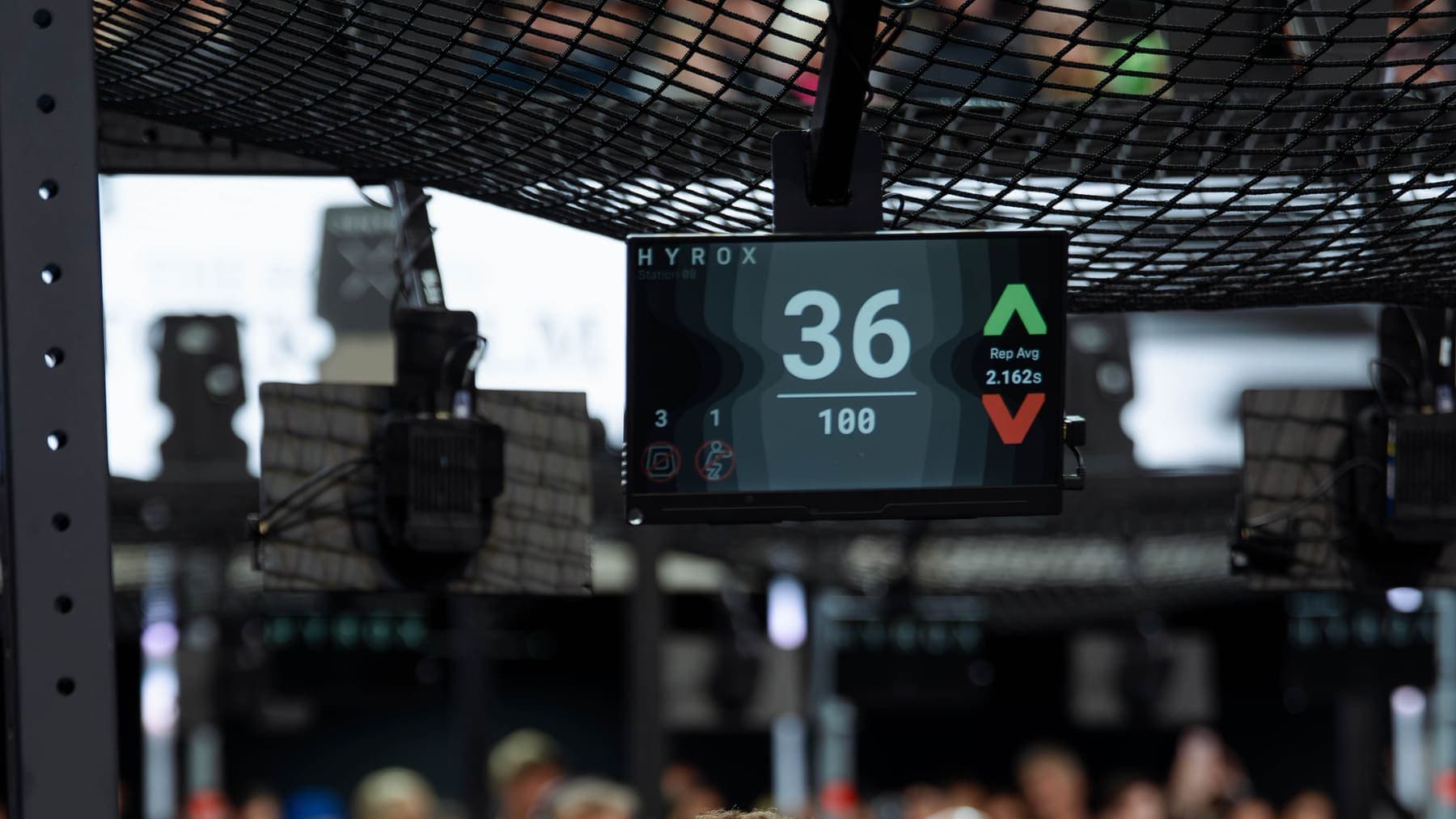
A HYROX contains nine movements: running, SkiErg, sled push, sled pull, burpee broad jumps, rowing, farmers carry, sandbag lunges and wall balls. That is the complete list. No barbell, no pull-ups, no muscle-ups, nothing requiring a skill you have to learn before you can compete.
That short list is the whole appeal of the event, and it changes how you should train for it.
Why trust this
Movement standards and loads below are read from the official HYROX singles rulebook for the 26/27 season. Ben Sutherland races Pro Doubles on the Elite 15 start list, so the training notes reflect racing these movements rather than reading about them.
The full list
| # | Movement | What it is | Primary demand | |---|---|---|---| | 0 | Running | 8 x 1km between stations | Aerobic capacity. Decides most finish times | | 1 | SkiErg | 1000m double-pole machine | Lats, triceps, trunk, lungs | | 2 | Sled push | 50m, 4 x 12.5m | Leg drive, horizontal force | | 3 | Sled pull | 50m, 4 x 12.5m, rope | Lats, grip, lower back | | 4 | Burpee broad jumps | 80m | Full body, heart rate | | 5 | Rowing | 1000m | Legs and back, but recoverable | | 6 | Farmers carry | 200m, two kettlebells | Grip, trunk, shoulders | | 7 | Sandbag lunges | 100m | Quads, single-leg endurance | | 8 | Wall balls | 100 reps | Legs, shoulders, willpower |
Loads vary by division. Women's Open runs 102kg sled push, 78kg sled pull, 2 x 16kg carry, 10kg sandbag and a 4kg wall ball to 2.70m. Men's Open and Women's Pro share a column at 152kg, 103kg, 2 x 24kg, 20kg and a 6kg ball to 3.00m. Men's Pro runs 202kg, 153kg, 2 x 32kg, 30kg and a 9kg ball. Sled weights include the sled.
What each movement actually trains
Running is not one of nine equal movements. It is roughly half the race by time for most athletes, and it is the strongest predictor of finish time. If you train one thing, train this.
SkiErg is a horizontal pulling pattern driven by the lats and trunk, not the arms. It lands first, when you are freshest, which is exactly why people overcook it.
Sled push is pure horizontal leg drive. It has almost no carryover from squatting heavy. The skill is body position, not maximal strength.
Sled pull is a seated or standing hand-over-hand row. It hits the lats and grip, and it quietly wrecks your farmers carry three stations later.
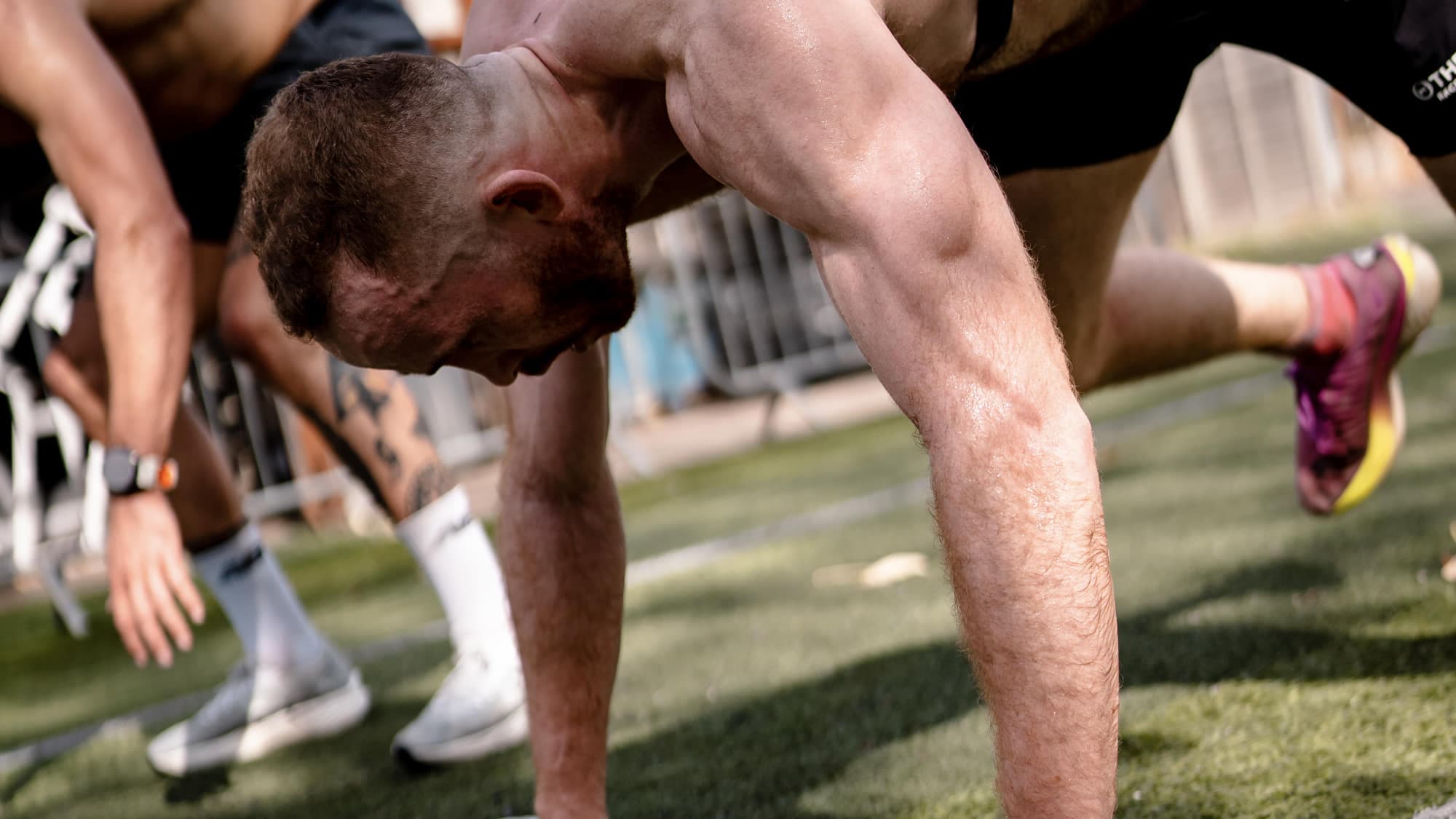
Burpee broad jumps are the only movement with meaningful technical penalty risk, because of the 5cm foot-stagger rule on take-off and landing and the 30cm hand-placement limit. They spike heart rate more than anything else in the race.
Rowing is the one station where sitting still and breathing is a legitimate tactic. Treat it as recovery and you get a minute back later.
Farmers carry is a grip and trunk test, arriving after your grip has already been taxed by the sled pull.
Sandbag lunges are single-leg endurance under load, at station seven, when your quads are gone. This is where a lot of races quietly end.
Wall balls are a squat-to-push pattern repeated 100 times with a target standard that has to be met every rep. Last station, no run afterwards, by design.
The practical part: how to train nine movements without nine sessions
You do not need a session per movement. Cluster them.
- Three runs a week, non-negotiable. One easy, one intervals (6 x 400m or 5 x 1km at goal pace), one longer easy run. This is the highest-return training available to you.
- Two full-body strength sessions. Squat pattern, hinge, push, pull, carry. That covers the demands behind the sleds, lunges and wall balls without needing the equipment.
- One compromised session a week. Erg hard, then run. Sled, then run. This is the specific sensation of the race and it cannot be trained by running alone.
- Wall balls in volume, weekly. Sets of 20-25 adding to 100+ total. The last 30 reps are the ones that decide your finish and you cannot rehearse them by doing sets of ten.
- Grip work you would otherwise skip. Heavy carries, dead hangs. Grip is the failure point at two separate stations.
If your gym has no sled, substitute heavy prowler-style pushes, hill sprints or a weighted march. Body angle transfers better than load does. If your gym has no SkiErg, use a rower and add lat pulldowns. Not identical, close enough. If you cannot access a sandbag, a heavy backpack or a barbell in a front-rack position works for lunges.
Common mistakes
Training the stations more than the running. The stations are visible and dramatic. The running is where the time is.
Training the sled at plate weight rather than total weight. Sled weights include the sled. Loading 152kg of plate on a 45kg sled means training at nearly 200kg and concluding you cannot do it.
Practising wall balls fresh. They come last for a reason. Do them at the end of a session, tired, or you are training a different exercise.
Ignoring transitions. The Roxzone counts. Walking out of a station and starting to run within ten seconds is free time, and almost nobody rehearses it.
Honest limitations
A movement list tells you what happens, not how to periodise it. Nine movements is simple; sequencing twelve weeks of training around them is not, and this page does not attempt that.
Substitutes get you most of the way but not all of it. Sled work in particular has a specific feel, and if you can access a sled even once a fortnight before a race, do.
If you have a lower back or knee history, the sled push and the loaded lunges deserve professional guidance rather than enthusiasm.
Next step
Find out which of these nine is actually your limiter rather than guessing. The fitness assessment quiz gives you a straight answer in a few minutes.
The HYROX training plans turn the list into a structured block around your current running and strength.
Source: movement standards, distances, rep counts and division loads from the official HYROX singles rulebook, season 26/27.
[ FAQ ]
Frequently asked
What exercises are in HYROX?
Nine movements in total: running, SkiErg, sled push, sled pull, burpee broad jumps, rowing, farmers carry, sandbag lunges and wall balls. There are no barbell lifts and no gymnastics skills.
Do you need gym equipment to train for HYROX?
Not for most of it. Running is the highest-return training and needs nothing. Wall balls, lunges and burpees need very little. Only the sleds and the two ergs genuinely require a gym, and they are the movements that transfer most easily from substitutes.
What is the hardest HYROX exercise?
The sled push ends more first races than anything else, because it arrives at station two when athletes still feel fresh. But the running decides most finish times, since it is 8km split across eight fatigued efforts.
Written by
The Suth Performance teamCoaches and editors
The Suth Performance programming team, led by HYROX Elite 15 athlete Ben Sutherland. They write the training, technique and race-day guides on this site, and Ben reviews every one before it is published.
[ KEEP READING ]
Related guides
Training
5 workouts that build a faster HYROX burpee broad jump
The station that spikes heart rate harder than anything else, immediately before the one place you can recover. Five sessions for rhythm, legal form and recovery control.

Training
5 workouts that build a faster HYROX row
The only station where going slower can make you faster. Five sessions for sequencing, split discipline, and using the row as the recovery it was positioned to be.

Training
5 workouts that build faster HYROX sandbag lunges
Station seven, on quads that are already gone. Five sessions built on exposure rather than load, because the bag is not what makes this hard.