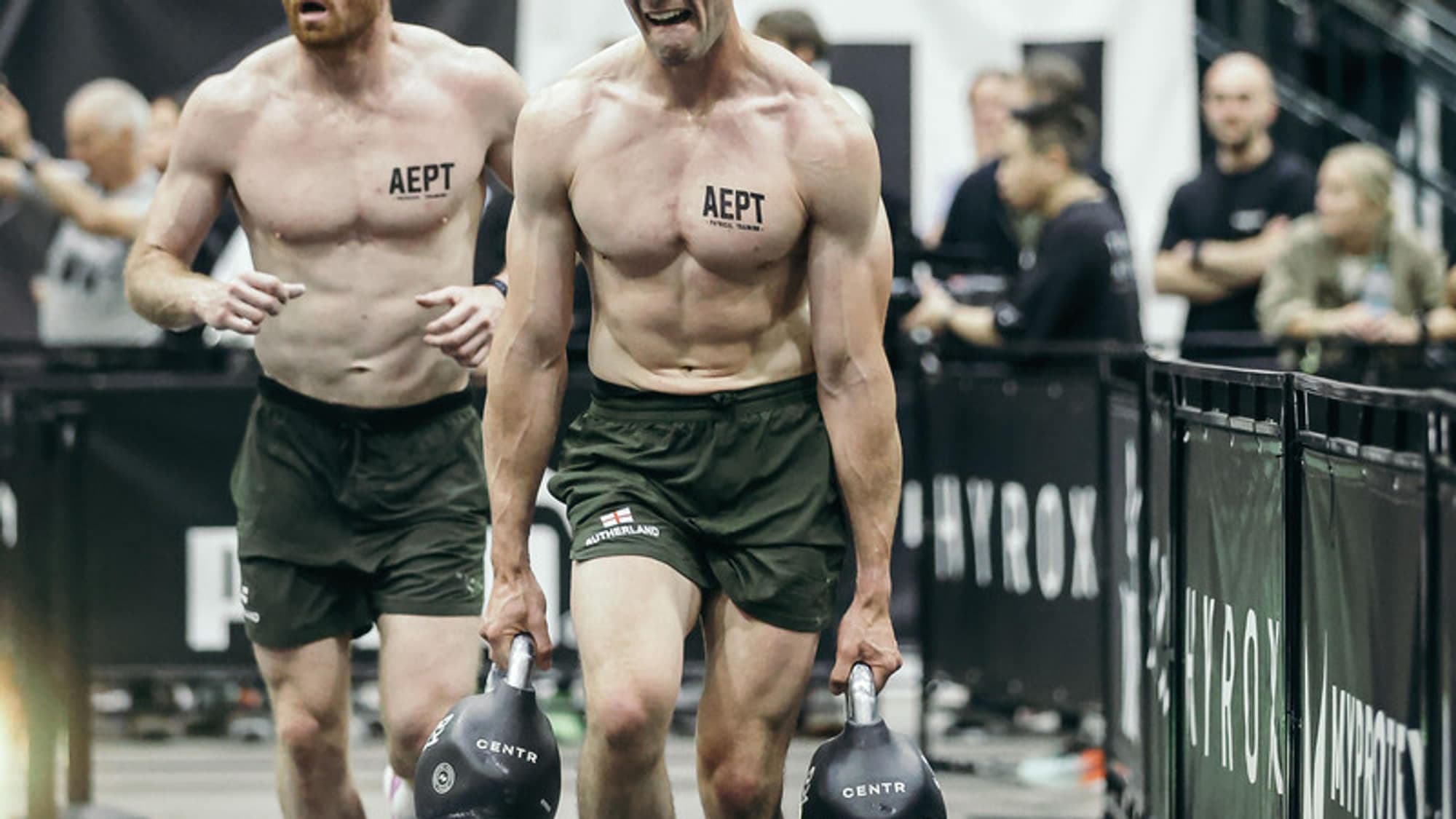
The farmers carry is 200m with two kettlebells at station six. It fails for one reason more than any other: your grip arrives already spent by the sled pull at station three, and almost nobody trains that coupling.
Every session below is built around it.
Why trust this
Loads and the station standard are read from the official 26/27 singles rulebook. Two things worth training to: both bells are carried at all times while you move, and the station begins and ends with removing and returning them from a marked box (a 30-second penalty if you get that wrong, avoidable if corrected before leaving the Roxzone).
Loads are 2 x 16kg Women's Open, 2 x 24kg Men's Open and Women's Pro, 2 x 32kg Men's Pro.
1. The coupling
The most important session on this page and the one people skip.
- Work: 4 rounds of: heavy hand-over-hand rope pull or 10 heavy dumbbell rows, then immediately 100m carry at race weight, then 90 seconds rest.
- Why: this is the race's actual demand. Grip that is fresh is not the grip the race asks for.
- Expect: the carry to feel notably worse than a fresh one. That gap is what you are closing.
2. Timed holds
Raw grip endurance.
- Work: 5 x 60-second holds at race weight or slightly heavier, 90 seconds rest.
- Progression: add 10 seconds a week, or add weight once you reach 90 seconds.
- Focus: firm, not maximal. Death-gripping at second one guarantees failure at second forty.
3. Unbroken distance
- Work: 1 x 250m at race weight, unbroken.
- Rule: if you have to stop, slow down instead. In the race you must carry both bells at all times while moving, so never rehearse setting them down.
- Focus: keeping the bells quiet. Swinging bells cost energy and destabilise the trunk.
4. Compromised carry
- Work: 3 rounds of: 1km run at goal pace, then 200m carry at race weight.
- What it teaches: the full station distance with your heart rate already high, which changes the grip demand considerably.
5. Grip support work
Twice a week, tacked onto other sessions.
- Work: 4 x 30-second dead hangs, 3 x 10 plate pinches, 3 x 12 wrist-roller or towel-grip rows.
- Why: grip is the failure point at two separate stations, and it is the most commonly skipped quality in HYROX preparation.
How to know it is working
Grip progress is slow and hard to feel, so measure it rather than guessing.
| Test | Do it | Progress looks like | |---|---|---| | Fresh 200m carry | Monthly, at race weight | Faster, and unbroken | | Coupled carry (session 1) | Monthly | Gap to the fresh time shrinking | | 60-second hold | Fortnightly | More weight, or more time | | Dead hang | Fortnightly | 45s, then 60s |
The number that matters is the gap between your fresh carry and your coupled carry. A fresh carry that improves while the coupled one does not means you are training the wrong thing.
What tends to fail first
Not the hands, usually. In a 200m carry at race weight the sequence is typically: forearms burn around 80m, the bells start to swing around 120m, the shoulders round forward, and then the hands go.
Each of those has a different fix. Swinging bells mean your trunk has given up, not your grip, so trunk work helps more than more hanging. Rounding shoulders mean you are bracing the arms against your legs rather than letting them hang.
Putting it into a week
| Day | Session | |---|---| | Mon | Strength, finishing with grip support (5) | | Tue | Threshold run | | Wed | Rest or easy | | Thu | The coupling (1), or compromised carry (4) later in the block | | Fri | Strength, finishing with timed holds (2) | | Sat | Long easy run | | Sun | Rest |
Honest limitations
Grip strength improves relatively slowly compared with technique or conditioning. If it is genuinely your limiter, start this work earlier in the block than feels necessary.
Kettlebell handle thickness varies between venues and manufacturers, and a thicker handle genuinely is harder to hold. Train on what you have and accept variance on the day.
Chalk is permitted at the farmers carry and the sled pull, but only chalk the event provides, and availability varies. Bringing your own, or using it anywhere else, is a 2-minute penalty. Do not build a plan that depends on it.
Next step
For the faults and the marked-box penalty, see farmers carry mistakes.
For the sled pull that creates the problem, see sled pull mistakes.
The fitness assessment quiz will tell you whether grip is genuinely where your time goes.
Source: loads, the carrying requirement and marked-box rule from the official HYROX singles rulebook, season 26/27.
Related
[ FAQ ]
Frequently asked
How do you improve grip for HYROX?
Train it after pulling rather than fresh, because that is the state the race presents it in. Heavy carries, dead hangs and timed holds twice a week, starting earlier in the block than feels necessary since grip improves slowly.
How heavy should you train the farmers carry?
At race weight for distance work, and slightly heavier for short holds. Race loads are 2 x 16kg, 2 x 24kg or 2 x 32kg depending on division.
Why does my grip fail in a HYROX but not in training?
Because in the race your grip has already been taxed by the sled pull three stations earlier. Training carries fresh rehearses a different exercise.
Written by
The Suth Performance teamCoaches and editors
The Suth Performance programming team, led by HYROX Elite 15 athlete Ben Sutherland. They write the training, technique and race-day guides on this site, and Ben reviews every one before it is published.
[ KEEP READING ]
Related guides

Training
15 HYROX workouts for every fitness level
Fifteen sessions you can do this week, grouped by whether you are starting out, building, or sharpening for a race. Most need nothing more than a treadmill and a couple of kettlebells.
Training
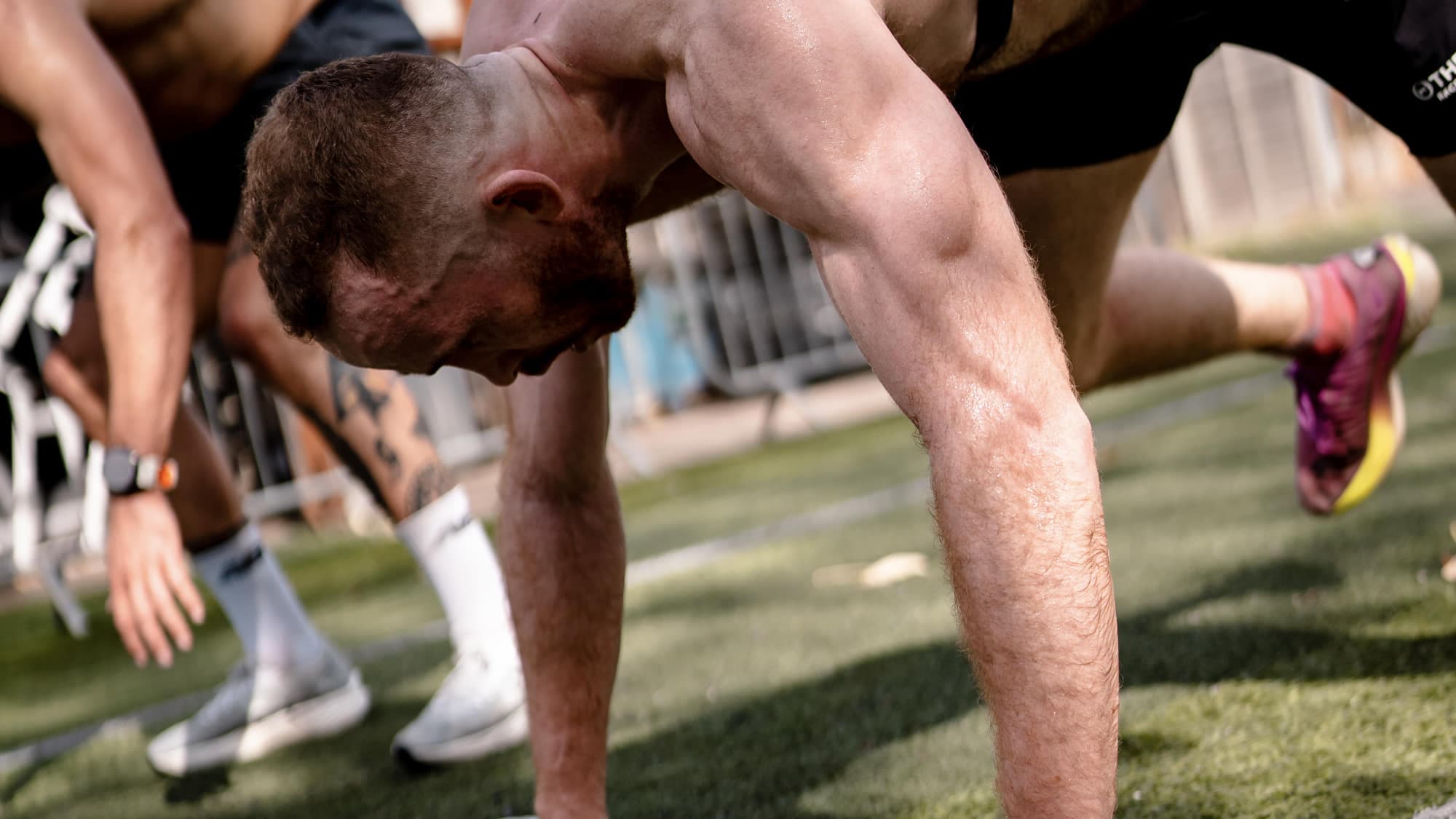
5 workouts that build a faster HYROX burpee broad jump
The station that spikes heart rate harder than anything else, immediately before the one place you can recover. Five sessions for rhythm, legal form and recovery control.
Training
5 workouts that build a faster HYROX row
The only station where going slower can make you faster. Five sessions for sequencing, split discipline, and using the row as the recovery it was positioned to be.