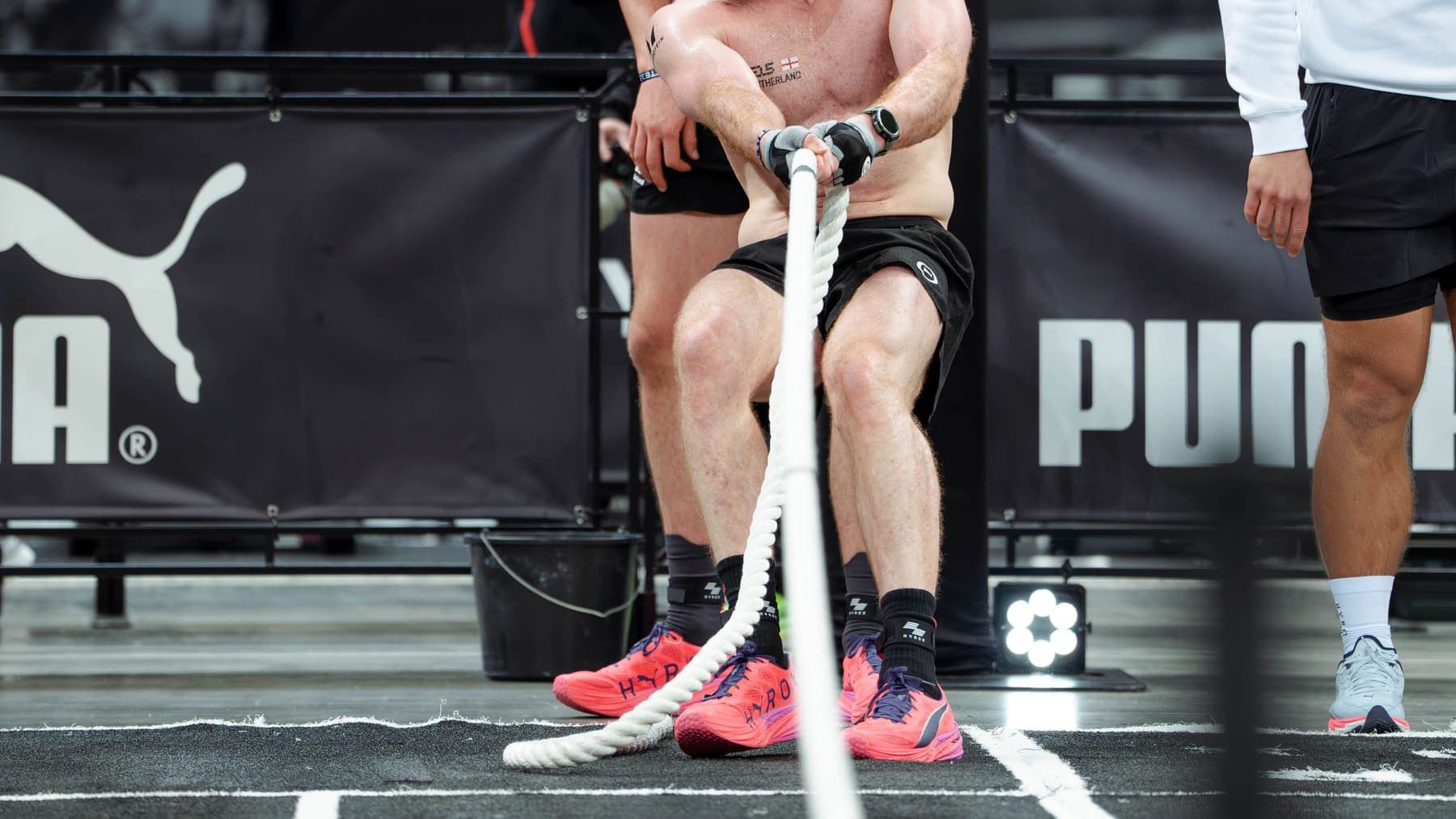
The sled pull has more positional rules than any other HYROX station, and its real cost lands three stations later at the farmers carry. These five sessions build the pull and pay off the grip debt at the same time.
Why trust this
Loads and the movement standard are read from the official 26/27 singles rulebook. The rules that shape how you should train: you must stay inside the Racers Box, you may not step on the solid line at the front or back while holding the rope, and you must remain standing at all times, so no pulling from a seated or kneeling position.
Loads are 78kg Women's Open, 103kg Men's Open and Women's Pro, 153kg Men's Pro.
1. Legal position work
- Work: 6 x 12.5m at race weight, full recovery, walking back between.
- Set-up: mark a box on the floor with tape and stay inside it. Rehearse the constraint, not just the movement.
- Focus: hips back, trunk braced, hand-over-hand rhythm, body weight moving backwards. Arms are hooks.
If you only ever pull without a marked box, you will find the box on race day and it will cost you.
2. Continuous rhythm
Static friction is much higher than moving friction, so a stopped sled is expensive.
- Work: 5 x 25m at race weight, 90 seconds rest.
- Rule: never let the rope go slack. Small continuous pulls beat big pulls with stalls between them.
- Progression: same session, 75 seconds rest.
3. Lat and hinge strength
The engine, on a non-rope day.
- Work: 4 x 8 weighted pull-ups or heavy lat pulldowns, 4 x 8 heavy dumbbell rows each side, 4 x 6 Romanian deadlifts, 3 x 10 face pulls.
- Why: the pull is a lat and hinge movement with a braced trunk. Building those directly transfers well, which is not true of every station.
4. The grip coupling
The session that pays off at station six.
- Work: 4 rounds of: 12.5m sled pull at race weight, then straight into a 100m farmers carry at race weight, then 90 seconds rest.
- Why: in the race your grip reaches the carry already spent by this station. Almost nobody rehearses that sequence.
5. Compromised pull
- Work: 3 rounds of: 1km run at goal pace, then 50m sled pull at race weight.
- What it teaches: pulling with your heart rate already high, which changes both your position and how fast your grip fades.
How to know it is working
| Test | Do it | Progress looks like | |---|---|---| | Full 50m, fresh | Monthly | Faster, no stalls | | 5 x 25m (session 2) | Fortnightly | Same times, shorter rest | | Coupled pull-carry (4) | Monthly | Carry holding up after the pull | | Weighted pull-up | Monthly | More load for the same reps |
What tends to fail first
Grip, then position. As the hands go, athletes start reaching further to compensate, which pushes them towards the box line and towards a penalty.
If you notice yourself creeping forward, take shorter reaches rather than bigger ones. A slightly slower legal pull beats a fast one with a 15-second penalty on it.
Substitutes if your gym has no rope
Heavy seated cable rows, hand-over-hand pulls on any rope and weight you can rig, sled drags with a harness, and heavy dumbbell rows. Add dead hangs twice a week regardless.
None of these is the real thing. If you can get to a rope even once a fortnight, do.
The fitness assessment quiz will tell you whether this station is genuinely where your time goes, or whether your running is.
Honest limitations
Rope thickness and rig height vary between venues and change how the station feels. The positional rules do not change, so train to those.
Grip improves slowly. If it is your limiter, start earlier in the block than feels necessary.
If you have an elbow or lower back history, loaded hand-over-hand pulling deserves a professional opinion first.
Next step
For the faults and the rules that carry penalties, see sled pull mistakes.
For the station this one sets up, see farmers carry workouts.
Source: loads, Racers Box rules and the standing requirement from the official HYROX singles rulebook, season 26/27.
Related
[ FAQ ]
Frequently asked
How do you train the HYROX sled pull without a rope setup?
Heavy seated cable rows, hand-over-hand pulls on any rope and sled you can rig, and heavy dumbbell rows are the closest substitutes. None replaces the real thing, so use a rope even once a fortnight if you can.
What muscles does the sled pull use?
Lats and mid-back for the pull, trunk for the brace, legs and hips for the body weight you move backwards, and grip throughout. Athletes who feel it only in their arms are pulling with the wrong things.
How heavy is the HYROX sled pull?
78kg in Women's Open, 103kg in Men's Open and Women's Pro, 153kg in Men's Pro, all including the sled. The distance is 50m as four lengths of 12.5m.
Written by
The Suth Performance teamCoaches and editors
The Suth Performance programming team, led by HYROX Elite 15 athlete Ben Sutherland. They write the training, technique and race-day guides on this site, and Ben reviews every one before it is published.
[ KEEP READING ]
Related guides
Training
5 workouts that build a faster HYROX burpee broad jump
The station that spikes heart rate harder than anything else, immediately before the one place you can recover. Five sessions for rhythm, legal form and recovery control.

Training
5 workouts that build a faster HYROX row
The only station where going slower can make you faster. Five sessions for sequencing, split discipline, and using the row as the recovery it was positioned to be.

Training
5 workouts that build faster HYROX sandbag lunges
Station seven, on quads that are already gone. Five sessions built on exposure rather than load, because the bag is not what makes this hard.