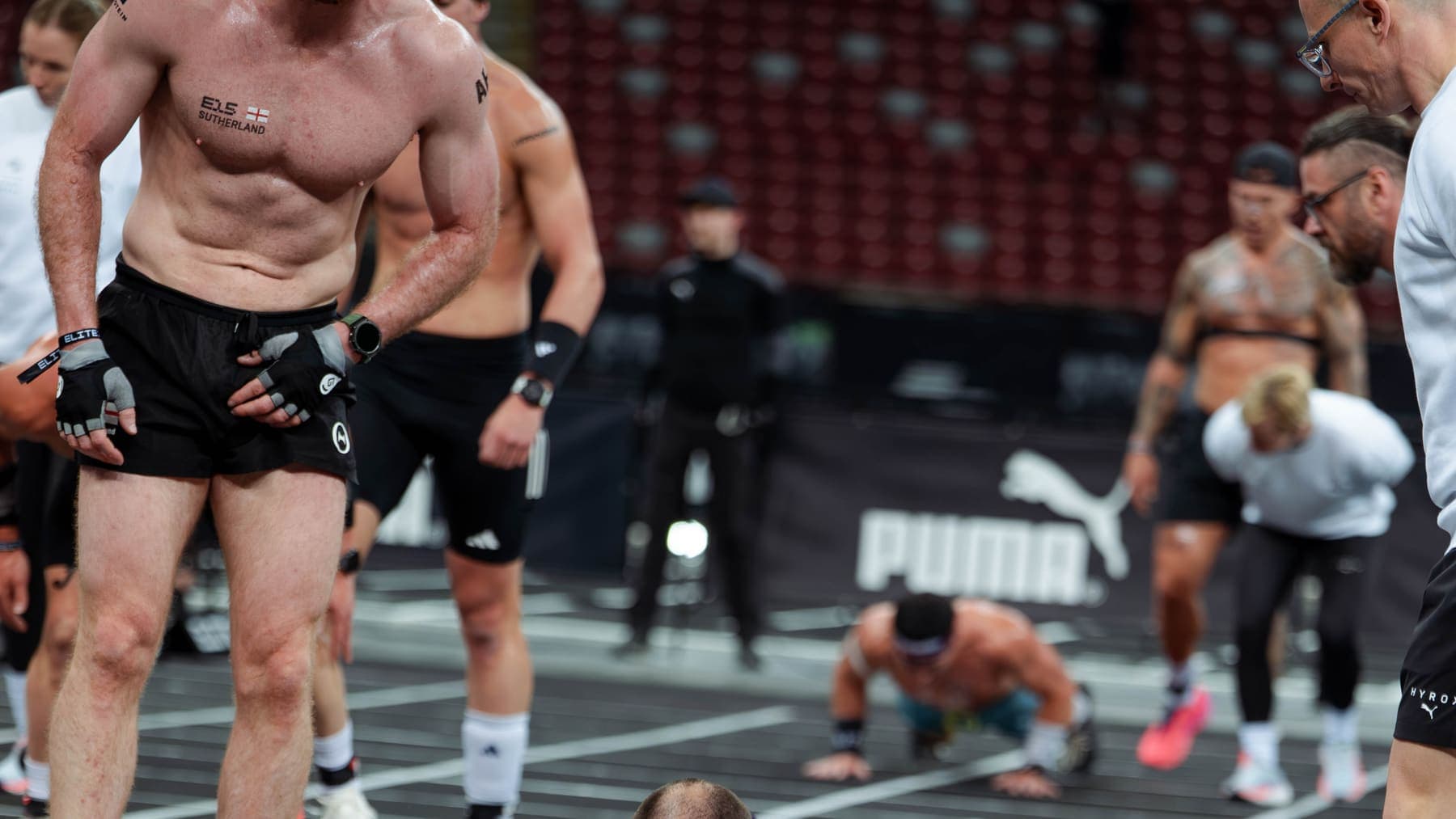
The burpee broad jump is the station with the most misunderstood rule in HYROX. Most people believe there is a minimum jump distance. There is not. Once you know that, the whole strategy inverts: short jumps are legal, so under fatigue you should shorten them and protect your landings rather than reaching for distance and risking a call.
Why trust this
The movement standard below is read from the official 26/27 singles rulebook. An earlier version of this site published a "minimum 1m per jump" rule and arithmetic built on it. That rule does not exist, and it has been corrected.
The standard, exactly
80 metres.
- The first burpee of each section starts with both hands on the ground behind the white start line and your chest on the ground, defined as the nipple line making clear contact.
- You may jump or step out of the burpee before broad jumping forward over the line.
- During all broad jumps, both feet must take off and land simultaneously, with a maximum 5cm variance between the front of one foot and the front of the other, on both take-off and landing.
- Additional steps or shuffles are not permitted at any time.
- When jumping or stepping out of any burpee, the feet cannot go beyond your fingertips.
- On subsequent burpees, hands must be placed no more than 30cm forward of the toes of your front foot, measured from the base of your palms. Once your hands are down, they cannot move forward.
- You may use a knee coming out of the bottom of the burpee.
The five mistakes
1. Jumping too far. The instinctive strategy is to cover ground in fewer jumps. But with no minimum distance, a long jump only buys you a slightly shorter station at a much higher heart-rate cost, and it makes a staggered landing far more likely as you tire.
The fix: moderate, repeatable jumps with clean landings. Consistency beats reach.
2. Staggered landings. The 5cm rule is tighter than people expect and it is the fault fatigue produces first. One foot creeps ahead and the rep gets called.
The fix: land deliberately with feet level. If you cannot, your jumps are too long. See fault one.
3. Not getting the chest down. Nipple line to the floor, every rep. Hovering is the classic tired-athlete fault and it is visible from a distance.
The fix: commit to full contact and accept the slightly slower rep. A no-rep costs more.
4. Creeping the hands forward. On each subsequent burpee the hands go no more than 30cm ahead of your front toes, and once down they cannot move forward. Athletes shuffle their hands to get more reach without realising it is a fault.
The fix: place your hands once, deliberately, and leave them.
5. Redlining. This station spikes heart rate harder than anything else in the race, and it sits at position four, immediately before the row. Athletes attack it and then cannot use the row for recovery.
The fix: treat it as a controlled effort. You want to arrive at the rower able to bring your heart rate down, not needing to.
The strategic consequence
Because short jumps are legal, the optimal approach late in the station is usually shorter jumps at a steadier rhythm, not fewer bigger ones. You will do more reps and lose less time to no-reps, staggers and the recovery cost of maximal jumping.
That is the opposite of what most athletes do, and it comes directly from a rule most of them have never read.
The faults at a glance
| Fault | Costs you | Fix | |---|---|---| | Jumping too far | Heart rate, and staggered landings | Moderate, repeatable jumps | | Staggered landing (>5cm) | The rep | Land feet level, shorten the jump | | Chest not down | The rep | Nipple line to the floor, every time | | Hands creeping forward | The rep | Place once, leave them | | Redlining | The row you needed for recovery | Controlled effort, not maximal |
The practical part: three sessions
- Standards work. 3 x 20m at an easy pace with someone watching your landings and hand placement. You are calibrating what legal feels like.
- Rhythm. 5 rounds of 20m burpee broad jumps with 60 seconds rest. Find a repeatable cadence you can hold when tired.
- The race pattern. 4 rounds: 20m burpee broad jumps, then 1km run. This is the position it occupies and the fatigue it creates.
Honest limitations
Judging can vary slightly in how strictly the 5cm stagger is applied, but the rule is unambiguous and many penalties are automatically detected rather than eyeballed. Train to the standard rather than to what you think you can get away with.
If you have wrist, shoulder or lower back issues, high-volume burpees are worth a professional conversation first.
Next step
For the full penalty structure across every station, see HYROX rules: standards, penalties and no-reps.
The fitness assessment quiz will tell you where your time is actually going.
Source: movement standard, the 5cm and 30cm rules and chest-contact definition from the official HYROX singles rulebook, season 26/27.
Related
[ FAQ ]
Frequently asked
Is there a minimum jump distance in HYROX burpee broad jumps?
No. The rulebook sets no minimum length. Short jumps are entirely legal, they are simply slower per rep. What is regulated is form: simultaneous take-off and landing within a 5cm stagger, chest contact, and hand placement.
What is the 5cm rule in burpee broad jumps?
Both feet must take off and land simultaneously, with a maximum variance of 5cm between the front of one foot and the front of the other. Any stagger greater than that is not permitted, and additional steps or shuffles are not allowed at any time.
How low do you have to go on a HYROX burpee?
Chest on the ground, which the rulebook defines as the nipple line making clear contact with the floor.

Written by
The Suth Performance teamCoaches and editors
The Suth Performance programming team, led by HYROX Elite 15 athlete Ben Sutherland. They write the training, technique and race-day guides on this site, and Ben reviews every one before it is published.
[ KEEP READING ]
Related guides

Technique
Farmers carry mistakes: what's costing you 60 seconds
Putting the bells down is the obvious mistake. The expensive ones are training grip fresh, not counting your laps, and losing the box on the way back in.
Technique
Rowing mistakes: what's costing you 60 seconds
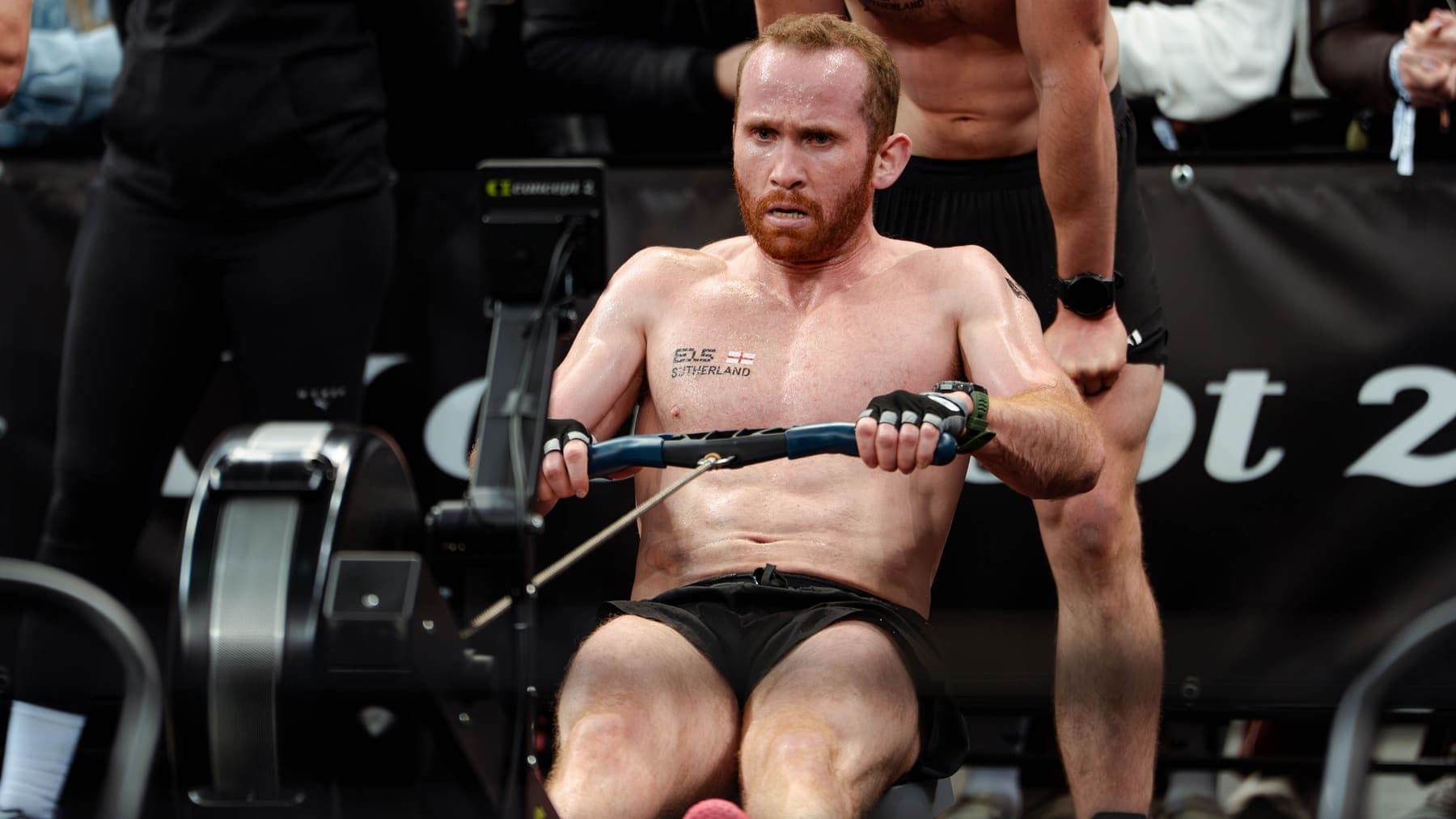
The row is the only genuine recovery in a HYROX, and most people spend it digging a deeper hole. Five faults, plus the rule that lets you rest mid-station without penalty.

Technique
Sandbag lunge mistakes: what's costing you 60 seconds
Station seven, quads already gone, and a bag that must stay on your shoulders. Five faults, including the resting position that costs 15 seconds every time you use it.