
The rower sits at station 5 of 8 in Hyrox. Your race is half done. You're tired but not broken. The next 1,000 m is a chance to settle, breathe, and set up a strong back half.
What the row actually demands
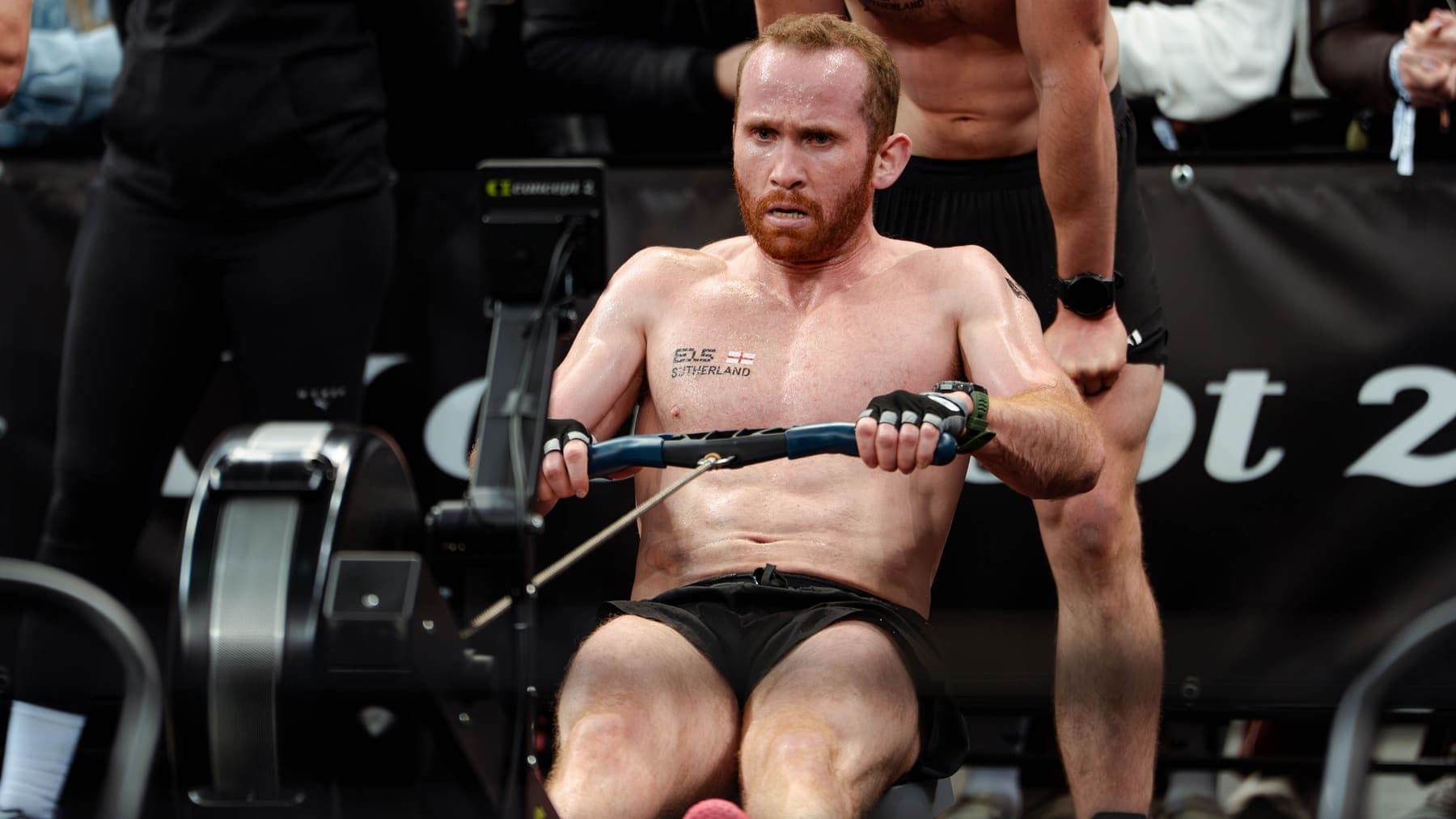
1,000 m on a Concept2 rower. Standard erg, monitored split per 500 m. You strap in, row, hit the distance, get out. Total time: 3:30-4:30 for most open athletes.
The movement is leg-first: drive with the legs, hinge the hips back, then pull with the arms. The reverse for the recovery: arms forward, hips forward, then legs bend back to the catch. Sequenced wrong, you waste 40% of the power.
Pace targets by category
| Category | 500 m split | 1000 m time | |---|---|---| | Open men (target sub-90) | 2:00-2:05 | 4:00-4:10 | | Open men (target sub-75) | 1:50-1:55 | 3:40-3:50 | | Open women (target sub-110) | 2:15-2:25 | 4:30-4:50 | | Open women (target sub-90) | 2:00-2:10 | 4:00-4:20 | | Pro / elite | 1:45-1:55 | 3:30-3:50 |
These are race-day targets at station 5 with 35-50 minutes of fatigue in your legs.
Posture under fatigue
The rowing technique most athletes know is the fresh technique. By station 5, you're tired and a tired athlete rounds the back, hunches the shoulders, and pulls with the arms.
What works under fatigue:
- Sit tall. Chest up, shoulders back. Even tired, lift the rib cage. This protects the lower back and lets you breathe.
- Legs first, always. The drive starts with the legs. If you start with arms, the legs follow weakly and you lose 30-50 watts.
- Long recovery. The slide back to the catch is your rest. Don't rush. Aim for a 1:2 drive-to-recovery ratio (the recovery takes twice as long as the drive).
Stroke rate
For Hyrox, stroke rate 26-30 per minute is the sweet spot. Higher rate burns more energy for the same boat speed; lower rate means you have to pull harder per stroke.
If you're new to rowing: row at 26 strokes per minute and focus on power per stroke. If you're experienced: 28-30 strokes per minute is your comfortable working zone.
Breathing pattern
Same as ski erg: one breath per stroke is the cleanest. Inhale on the recovery, exhale on the drive. Sustainable. Predictable.
If you're under-paced and breathing too hard, drop the stroke rate by two and add a beat of inhale on the recovery. Recover within the stroke instead of trying to recover by stopping.
What kills row times
In order:
- Pulling with arms only. Wastes 40% of the power. The most common technique error.
- Bending the wrists. Keep wrists flat through the pull. Bent wrists lose force transfer.
- Rushing the recovery. Drive at 100%, recovery at 50%. Trying to "speed up" by rushing back is a net negative.
- Wrong split target. Going out at 1:50 for 200 m, finishing at 2:15 because the legs died. Pick one split, hold it for 1000 m.
The zero-cost transition
The rower-to-run transition is where 5-15 seconds is left on the table by 80% of the field. The technique:
- Last stroke at the prescribed split, no sprint finish. Don't blow up at metre 990.
- Sit forward, hands off the handle. Reach down.
- One smooth motion to release foot straps. Both feet free.
- Stand straight. Take one full breath.
- Walk 5-7 steps out of the rower zone. Lets your head settle and your legs find the floor again.
- Break into a jog. Slow first 30 m, normal pace after.
The athletes who sprint immediately out of the rower lose 5-15 seconds in the first 100 m of the run because their legs are still in rowing pattern and their balance is off.
Training the row for Hyrox
If your gym has a rower:
- Session A: 4 × 500 m at goal split + 90 s rest. Builds the pace.
- Session B: 2000 m at goal split + 5 min rest, then 1000 m at goal split. Builds the duration + race simulation.
Weekly, in the 6 weeks before race day. Once if you're well-trained; twice if rowing is a weakness.
If your gym has no rower: ski erg substitutes well; bike erg is acceptable. The aerobic adaptation transfers.
The honest summary
The row is the most forgiving Hyrox station because the pace target is clear and the technique is well-documented. The athletes who row well are the ones who:
- Pick a 500 m split target and hold it
- Drive with legs, finish with arms
- Sit tall under fatigue
- Recover patiently within each stroke
- Execute the clean transition
Train it twice a week for six weeks. Race it at your target split. Walk-jog out. The post-row 1 km run is where you settle for the back half of the race.
More on the row
- The faults that cost time on the row, and the rulebook standards behind them.
- Five sessions that build a faster the row, with benchmarks to test progress.
- The the row station page for the movement standard in full.
- Station order: what this station borrows, and where the bill arrives.
[ FAQ ]
Frequently asked
What pace should I target on the Hyrox rower?
Open men: 1:50-2:05 per 500 m. Open women: 2:05-2:20. Elite athletes: 1:40-1:50. Aim for a split you can hold for the full 1000 m without falling apart.
What damper setting?
Damper 5-7 for most. Higher feels powerful but burns by 500 m. Lower wastes time. Most fast Hyrox rowers stay 5-6.
Hands or straps?
Strap your feet in tight. Hands grip the handle, two fingers over and two under is the standard. Don't grip white-knuckle; you'll waste forearm energy.
What's the cleanest exit?
Finish your final stroke, sit forward, undo the foot straps in one motion, stand, walk five steps to clear your head, then jog into the next 1 km.

Written by
The Suth Performance teamCoaches and editors
The Suth Performance programming team, led by HYROX Elite 15 athlete Ben Sutherland. They write the training, technique and race-day guides on this site, and Ben reviews every one before it is published.
[ KEEP READING ]
Related guides

Technique
Ski erg for Hyrox: stroke rate, damper, and the 1-km split
The ski erg is station one. Get it wrong and you've taxed your shoulders for the next 80 minutes. The technique and pacing that protect the race.
Technique
Rowing mistakes: what's costing you 60 seconds
The row is the only genuine recovery in a HYROX, and most people spend it digging a deeper hole. Five faults, plus the rule that lets you rest mid-station without penalty.

Technique
Hyrox farmers carry: grip, pacing, and the strategy that earns back 40 seconds
The farmers carry is the deceptive station. Strong athletes drop the kettlebells; smart athletes finish in 90 seconds. The technique, breathing, and pacing that turn the carry into a recovery station instead of a redline.