
The HYROX station order is fixed worldwide: SkiErg, sled push, sled pull, burpee broad jumps, rowing, farmers carry, sandbag lunges, wall balls, with a 1km run before each one.
It never varies by event, and completing them out of order has its own penalty section in the rulebook. But the useful thing is not memorising the list. It is understanding that each station sets up the one after it, and that damage done early shows up late.
Why trust this
The sequence and its penalties are read from the official 26/27 singles rulebook. Ben Sutherland races Pro Doubles on the Elite 15 start list, so the pacing consequences below come from racing the order rather than reading it.
The sequence, and what each position does
| # | Station | Position effect | |---|---|---| | 1 | SkiErg | Arrives fresh. Easy to overcook because you feel good | | 2 | Sled push | Where most first races are decided, and not at the sled | | 3 | Sled pull | Taxes grip that station 6 will need | | 4 | Burpee broad jumps | Peak heart rate, nowhere to hide | | 5 | Rowing | The only genuine recovery in the race | | 6 | Farmers carry | Grip arrives already compromised by station 3 | | 7 | Sandbag lunges | Quads, at the point they are gone | | 8 | Wall balls | Last, by design. No run to hide in afterwards |
The three couplings that decide your race
Sled pull → farmers carry. Stations three and six. Your grip is taxed hand-over-hand on the rope, then asked to hold two kettlebells for 200m three stations later. Most people train grip fresh and are surprised when the carry fails. Train it after pulling.
Sled push → runs four, five and six. The push is legs, and legs are what the remaining 6km of running needs. This is the coupling nobody sees, because the sled split looks fine. The cost appears two or three kilometres later as a pace that quietly falls apart.
Everything → wall balls. One hundred reps of a squat-and-throw, last, with a movement standard that has to be met every single rep. The reason wall balls feel impossible is almost never wall balls. It is the seven stations before them.
Why the order is not arbitrary
Three things it does deliberately:
It front-loads the trap. The two heaviest stations arrive at positions two and three, when you feel strongest and are least able to judge your own effort. Adrenaline hides fatigue for roughly the first fifteen minutes, which is exactly the window the sleds occupy.
It puts recovery in the middle. The row at station five is the only place you can genuinely bring your heart rate down. Good racers use it; inexperienced racers attack it and lose the back half.
It ends on willpower. Wall balls last means the race finishes with the station most sensitive to accumulated fatigue and most likely to produce no-reps. That is the design.
The practical part: pacing the order
- Treat station one as a warm-up you are being timed on. The SkiErg is not where races are won and it is very much where they can be lost.
- Plan the sled push in segments before you touch it. Four sections of 12.5m gives you natural stopping points. Decide in advance; do not decide after failing.
- Sit on the row for the first 200m and breathe. Ten seconds lost, a minute returned.
- Train grip after pulling, not fresh. Do your carries immediately after a hard pulling movement so the sequence matches the race.
- Break wall balls from rep one. Sets of ten with a five-second reset beats sets of twenty-five and a collapse.
Honest limitations
Knowing the order does not pace the race for you, and the coupling effects vary by athlete. A strong puller with poor legs experiences a different race from a runner with no upper body, and both are reading the same sequence.
The order is also the one thing that genuinely does not change between venues. What does change, and what makes cross-venue comparison unreliable, is track layout, floor surface, Roxzone length and wave congestion.
Next step
For what each station demands individually, see the station guides or the full movement list.
The fitness assessment quiz will tell you which coupling is actually costing you.
Source: station sequence and the incorrect-order penalty from the official HYROX singles rulebook, season 26/27.
[ FAQ ]
Frequently asked
What is the order of HYROX stations?
SkiErg, sled push, sled pull, burpee broad jumps, rowing, farmers carry, sandbag lunges, wall balls, with a 1km run before each. The order is fixed by the rulebook and identical at every event worldwide.
Does the HYROX station order ever change?
No. The sequence is part of the standardisation that makes times comparable between events. Completing stations in the incorrect order carries its own penalty section in the rulebook.
Which HYROX station is hardest?
The sled push ends more first races than any other, because it lands at station two when adrenaline hides how hard you are working. But the damage usually shows up two or three stations later, not at the sled itself.
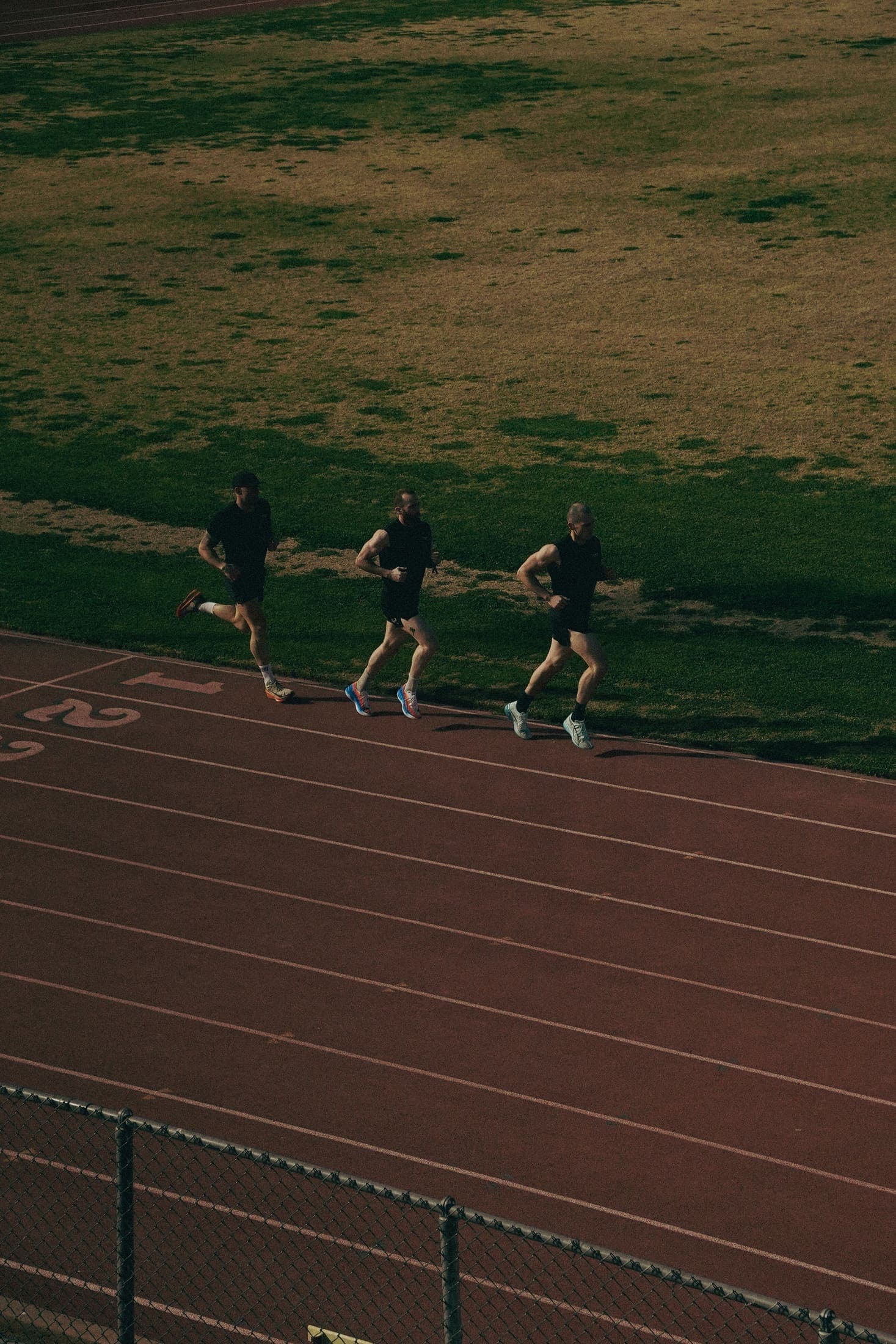
Written by
The Suth Performance teamCoaches and editors
The Suth Performance programming team, led by HYROX Elite 15 athlete Ben Sutherland. They write the training, technique and race-day guides on this site, and Ben reviews every one before it is published.
[ KEEP READING ]
Related guides
Race day
Hyrox race-day pacing: the eight stations, the seven runs, the one mistake nobody warns you about
Race-day pacing decides whether the build pays off or quietly falls apart at minute 60. A station-by-station plan, the warm-up that works, and the one error first-timers always make.

Race day
Hyrox first 5 km strategy: pace it like a finisher, not a runner
The opening half of the race decides the finish. Pacing the first five 1-km runs is a skill most first-timers learn the hard way.
Training
HYROX exercise order: why the sequence is the strategy
Nine movements in a fixed order that never changes. Which means the whole tactical problem is not what you do, but what each thing does to the next.