The HYROX sled push is 102kg in Women's Open, 152kg in Men's Open and Women's Pro, and 202kg in Men's Pro. Every one of those figures includes the sled itself. The distance is 50m in all divisions, run as four lengths of 12.5m.
That "including the sled" detail is the single most useful thing on this page, and it is why a lot of people arrive at their first race having trained far heavier than they needed to.
Why trust this
Figures are read directly from the official HYROX singles rulebook for the 26/27 season. Ben Sutherland races Pro Doubles on the Elite 15 start list, so the technique notes below come from someone racing at 202kg standard rather than from theory.
The official weights
| Division | Sled push weight | Distance | |---|---|---| | Women Open | 102kg incl. sled | 50m (4 x 12.5m) | | Men Open / Women Pro | 152kg incl. sled | 50m (4 x 12.5m) | | Men Pro | 202kg incl. sled | 50m (4 x 12.5m) |
Note again that Men's Open and Women's Pro share a column. They push the same sled.
The mistake almost everyone makes in training
Your gym sled has a weight of its own. Depending on the model that is anywhere from about 20kg to about 60kg empty.
If you are a men's Open athlete and you load 152kg of plate onto a 45kg sled, you are pushing 197kg. That is within touching distance of Men's Pro weight. You will conclude that the sled push is impossible, you will train it badly because every session is a grind, and you will arrive at your race having prepared for a station that does not exist.
Do this instead, once, this week:
- Find out what your gym's sled weighs empty. Ask, or check the manufacturer's spec.
- Write that number in your phone.
- Load to race weight minus sled weight from now on.
If your gym cannot tell you the sled weight, assume 40kg as a working estimate and note that your training is approximate. An approximate number you know about is better than a precise number that is wrong.
Why it ends so many first races
The sled push is station two. It arrives after just 2km of running, when you feel strong and the adrenaline is still up.
That combination is a trap. Athletes attack it, redline at kilometre two of an eight kilometre race, and spend the remaining six kilometres paying interest. The damage does not show up on the sled split. It shows up on runs four, five and six.
It is also the station where the floor matters most. Sled friction varies noticeably between venues depending on surface, and the same 152kg genuinely does feel different from hall to hall. That is a real and widely discussed variable, and it is why comparing your sled split to a friend's from another city tells you very little.
Technique that actually saves time
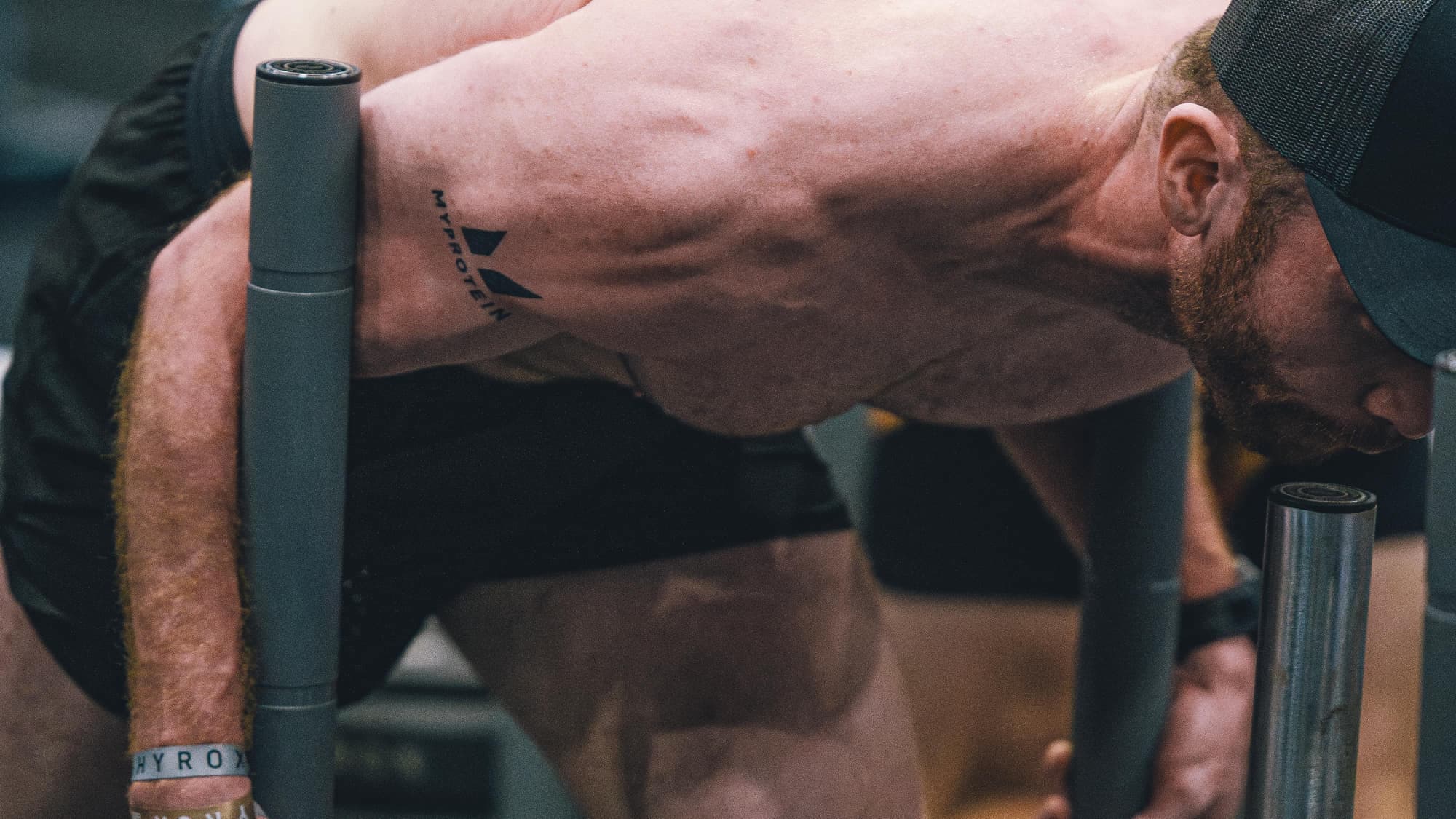
Get low. The most common fault is standing too upright. You want a long body angle, close to a straight line from hands to heels, so you are driving horizontally rather than pushing down into the floor.
Arms locked. Bent arms turn the push into a partial press and leak force. Lock out and let your legs do the work.
Short, choppy steps. Long strides mean a moment where neither foot is driving. Short steps keep continuous force on the sled. It looks less athletic and it moves the sled faster.
Head neutral, eyes down. Craning up to see the line costs you body angle.
Plan your breaks before you start. Four sections of 12.5m gives you four natural stopping points. Decide in advance whether you are pushing one, two or four segments at a time. Deciding mid-station, after you have already failed, is how a thirty second station becomes a two minute one.
The practical part: a four-week sled block
If your sled push is your limiter, this is the minimum effective dose. Twice a week, alongside your normal running.
- Week 1: 6 x 12.5m at race weight, full recovery between efforts. Focus entirely on body angle. You are learning a position, not building fitness.
- Week 2: 5 x 25m at race weight, 90 seconds recovery. Now you are learning to hold position while breathing hard.
- Week 3: 4 x 50m at race weight, 2 minutes recovery. Full station distance. Note your time on each.
- Week 4: 3 x (1km run, then 50m sled). This is the one that matters. Pushing a sled fresh has almost nothing to do with pushing it at race pace off a kilometre.
If you cannot move race weight at all, drop to a load you can push continuously for 12.5m and add roughly 10kg a week. Do not grind at a weight that forces you to stop every three metres, because you will only rehearse failure.
Honest limitations
Sled push strength is trainable and it is not usually the thing standing between you and a better finish time. Running is. Athletes obsess over the sled because it is the most visibly brutal station, but the eight kilometres of running decide far more of your result.
Venue friction also means there is a ceiling on how precisely you can prepare. You can train the position, the pacing and the breaks. You cannot train the floor you will get.
And if you have a lower back history, the sled push is a station to approach carefully and with professional guidance rather than enthusiasm.
Next step
Want to know whether the sled is actually your limiter, or whether it is your running? The fitness assessment quiz will tell you where you sit.
The HYROX training plans build sled work into a full block rather than leaving it as an isolated session.
Source: all weights and distances from the official HYROX singles rulebook, season 26/27.
Related
[ FAQ ]
Frequently asked
How heavy is the HYROX sled push?
102kg in Women's Open, 152kg in Men's Open and Women's Pro, and 202kg in Men's Pro. All three figures include the weight of the sled itself, not just the plates loaded onto it.
Does the HYROX sled weight include the sled?
Yes. The rulebook states the weights as including the sled. This is the most common training error in HYROX preparation, because gym sleds weigh between roughly 20kg and 60kg empty, so loading full race weight in plate puts you well above race standard.
How far is the HYROX sled push?
50 metres in total, run as four lengths of 12.5 metres, with a turn at the end of each length.

Written by
The Suth Performance teamCoaches and editors
The Suth Performance programming team, led by HYROX Elite 15 athlete Ben Sutherland. They write the training, technique and race-day guides on this site, and Ben reviews every one before it is published.
[ KEEP READING ]
Related guides
Technique
Sled push mistakes: what's costing you 60 seconds
Standing too tall, bent arms, long strides and no plan. Four faults that turn a 90-second station into a three-minute one, and the loading error people make in training.
Technique
Burpee broad jump mistakes: what's costing you 60 seconds
There is no minimum jump distance, which changes the whole strategy. Five faults, the 5cm rule almost nobody knows, and why long jumps are usually the wrong answer.

Technique
Farmers carry mistakes: what's costing you 60 seconds
Putting the bells down is the obvious mistake. The expensive ones are training grip fresh, not counting your laps, and losing the box on the way back in.