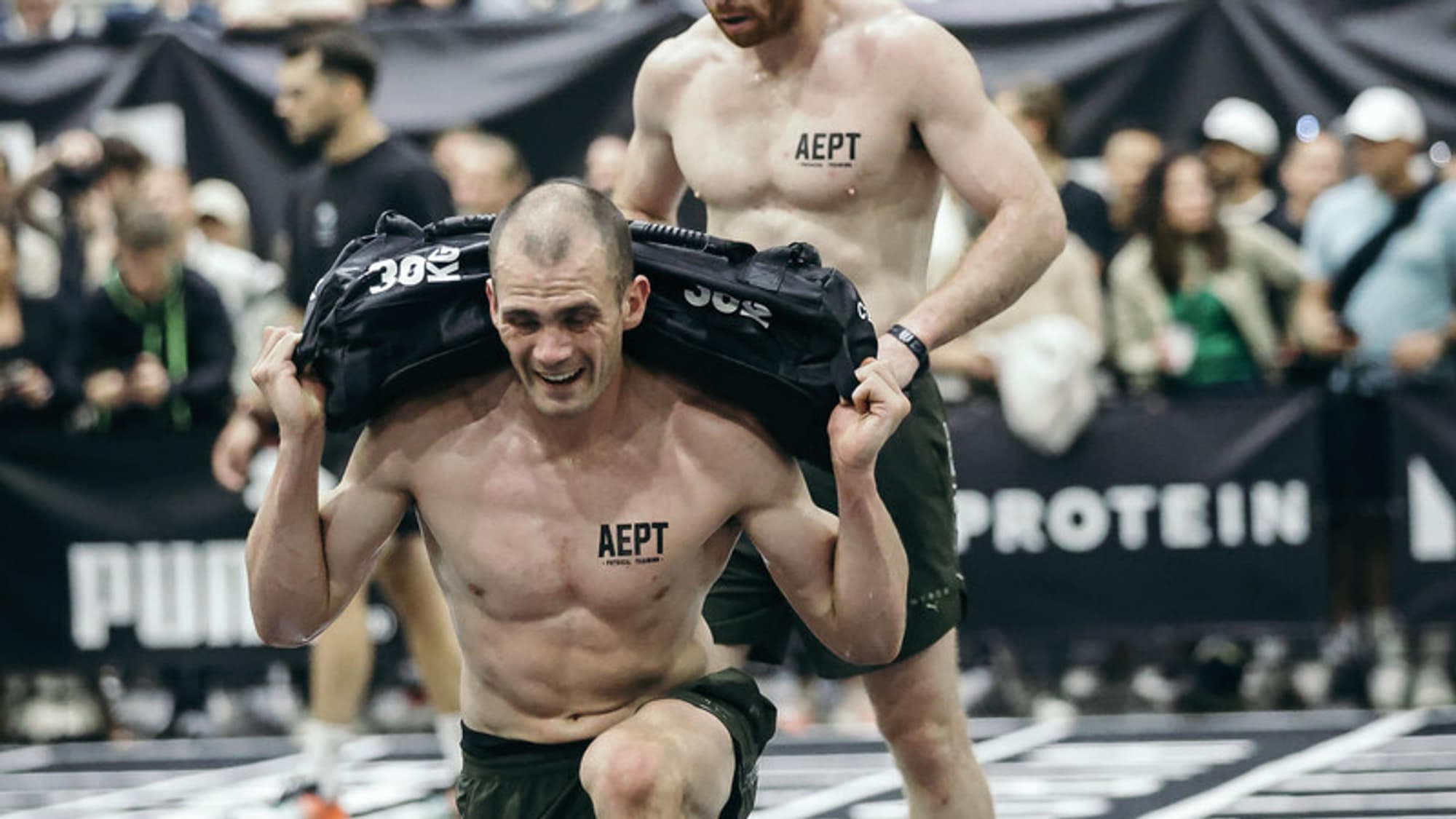
Sandbag lunges sit at station 7 of 8 in Hyrox. Your legs are already tired. You've just finished the farmer's carry. You have wall balls and the final 1 km run ahead. The lunge is where many first-timers' races fall apart.
What the sandbag lunges demand
100 m of walking lunges with a sandbag across your shoulders. The lunge has to be controlled (back knee touching the ground each rep) and the bag has to stay above the shoulders. Drop the bag, do a 5-burpee penalty. Fail to touch the back knee, the rep doesn't count.
The physical demand: posterior chain, quads, hip flexors, core. The aerobic demand: massive. Lunging while breathing under load is one of the hardest combined demands in fitness racing.
Carry position: shoulders, not anywhere else
Three carry positions athletes use. Only one of them works at race-day distance:
1. Behind the neck, on the trap shelf. This is the right answer. Bag balanced across the back of the shoulders, hands gripping the front of the bag near the ears. The weight sits on bone (the shoulders) instead of muscle. You can carry it for the full 100 m without shoulder fatigue.
2. Bear hug / front rack. Bag clutched to the chest. Faster to set up but kills the shoulders by metre 30. Avoid.
3. Overhead. Looks elite. Wastes massive energy and risks bag drops. Avoid.
The behind-the-neck position takes 5-10 seconds longer to set up before you start lunging. That investment is recovered within the first 20 metres.
Lunge depth and rhythm
The rep:
- Step forward, controlled.
- Back knee gently touches the floor.
- Drive up through the front heel.
- Front leg fully extends before you start the next rep.
- Alternate legs.
The cadence: one lunge every 2-3 seconds. That's slower than your training body wants to go. Resist the urge to rush.
Common mistake: bouncing the back knee off the floor. That's an injury risk and an automatic no-rep at most events. Touch and stand.
Breathing: one breath per lunge
The breathing pattern that works for most athletes:
- Inhale on the step forward.
- Brace through the descent.
- Exhale through the drive up.
Repeat. One breath cycle per lunge. Predictable, calming, sustainable for the full 100 m.
The pattern that doesn't work: holding your breath through 3-4 lunges then gasping. You'll go dizzy by metre 50 and either drop the bag or stop.
The 4-step recovery trick
If you must stop mid-lunge to recover, here's the technique that costs least:
- Stand fully upright with the bag still on your shoulders. Don't drop it.
- Take 3-4 slow, controlled deep breaths. Belly breathing.
- Shake out the front leg. Wiggle the toes.
- Step into the next lunge. Re-engage at slower cadence.
Total stop time: 10-15 seconds. Compare to dropping the bag (5-burpee penalty + re-set + losing the carry position) which costs 60-90 seconds.
If you can do the whole 100 m without stopping, do that. If you must stop, the 4-step recovery is the cheapest way.
Pacing: the wall ball test
The sandbag lunges sit before the wall ball. If you lunge too hard, your legs are toast for the 100 wall balls that follow. If you lunge too easy, the wall ball is easier but you've lost 60 seconds on the lunge station.
| Pacing | What it costs you | |---|---| | Too hard | Legs gone for the 100 wall balls that follow | | Too easy | Around 60 seconds lost on the lunge itself | | About right | Breathing hard, not gasping; legs heavy but able to squat |
The self-test in training: after a hard 100m lunge, can you do 20 unbroken wall balls without resting? If yes, the pacing is right.
The right pacing target: finish the lunge breathing hard but not gasping. Heart rate elevated but not at maximum. Legs heavy but able to squat.
A useful self-test in training: after a hard 100 m lunge in your wall ball preparation, can you immediately do 20 unbroken wall balls without resting? If yes, your lunge pacing is correct. If no, slow the lunge.
Training the sandbag lunge
Two specific weekly sessions in the 6 weeks before race day:
Session 1: distance work. 4 × 100 m at race-bag weight, 2 min rest between. Unbroken. Builds the muscular endurance.
Session 2: combo work. 50 m sandbag lunge + 25 wall balls + 50 m sandbag lunge + 25 wall balls + 50 m sandbag lunge + 25 wall balls. One round. Builds the transition that decides race day.
That's it. More volume than this and the recovery starts hurting other sessions. Less and you arrive on race day with intact technique but no muscular endurance.
The grip is overlooked
The sandbag lunge looks like a leg exercise but it's also a grip + core challenge. The bag rests on your shoulders but your hands hold it in place. If your hands slip, the bag rolls forward and you have to re-set or drop.
In training, never use lifting straps for sandbag work. The race-day grip comes from training grip.
The honest summary
The sandbag lunge is the second most race-deciding station after the wall ball. Pacing matters more than strength. Technique matters more than power. The athletes who finish the lunge fast and arrive at the wall ball fresh are the ones who:
- Set up the bag correctly behind the neck
- Hold steady cadence (one lunge per 2-3 seconds)
- Breathe in a pattern, not gasps
- Don't go all-out; save for the wall ball
Train it weekly. Train it in a tired state. Race it at 75-80% effort. The minutes you save on the lunge by going hard, you lose on the wall ball by twice as much.
More on sandbag lunges
- The faults that cost time on sandbag lunges, and the rulebook standards behind them.
- Five sessions that build a faster sandbag lunges, with benchmarks to test progress.
- The sandbag lunges station page for the movement standard in full.
- Station order: what this station borrows, and where the bill arrives.
Next step
Lunge tolerance is built by exposure across weeks, not by one good session. The HYROX training plans put that exposure in the right places.
The fitness assessment quiz tells you whether the lunges are actually your limiter.
[ FAQ ]
Frequently asked
How heavy is the Hyrox sandbag?
Open men's: 20 kg. Open women's: 10 kg. Pro: 30 kg men / 20 kg women. Doubles uses the same weight split between two athletes for the 100 m lunge distance.
Where do you carry the sandbag?
On the back of the shoulders, behind the neck. Holding it over your head or in front of your chest is faster initially but ruins your shoulders and posture by metre 40.
Can you stop and rest?
Yes, but try not to. Each stop costs 3-5 seconds in re-set. A controlled, unbroken 100 m lunge at slower pace beats 2x 50 m fast-then-stopped in nearly every case.
What's a good time for the sandbag lunge?
Open men: 3-5 minutes. Open women: 3:30-5:30. Elite athletes finish in under 2:30. The athlete who lunges 100 m unbroken at conversational breath wins the next station.
Written by
The Suth Performance teamCoaches and editors
The Suth Performance programming team, led by HYROX Elite 15 athlete Ben Sutherland. They write the training, technique and race-day guides on this site, and Ben reviews every one before it is published.
[ KEEP READING ]
Related guides
Technique
Hyrox sled pull technique: feet, hands, and the rhythm that wins
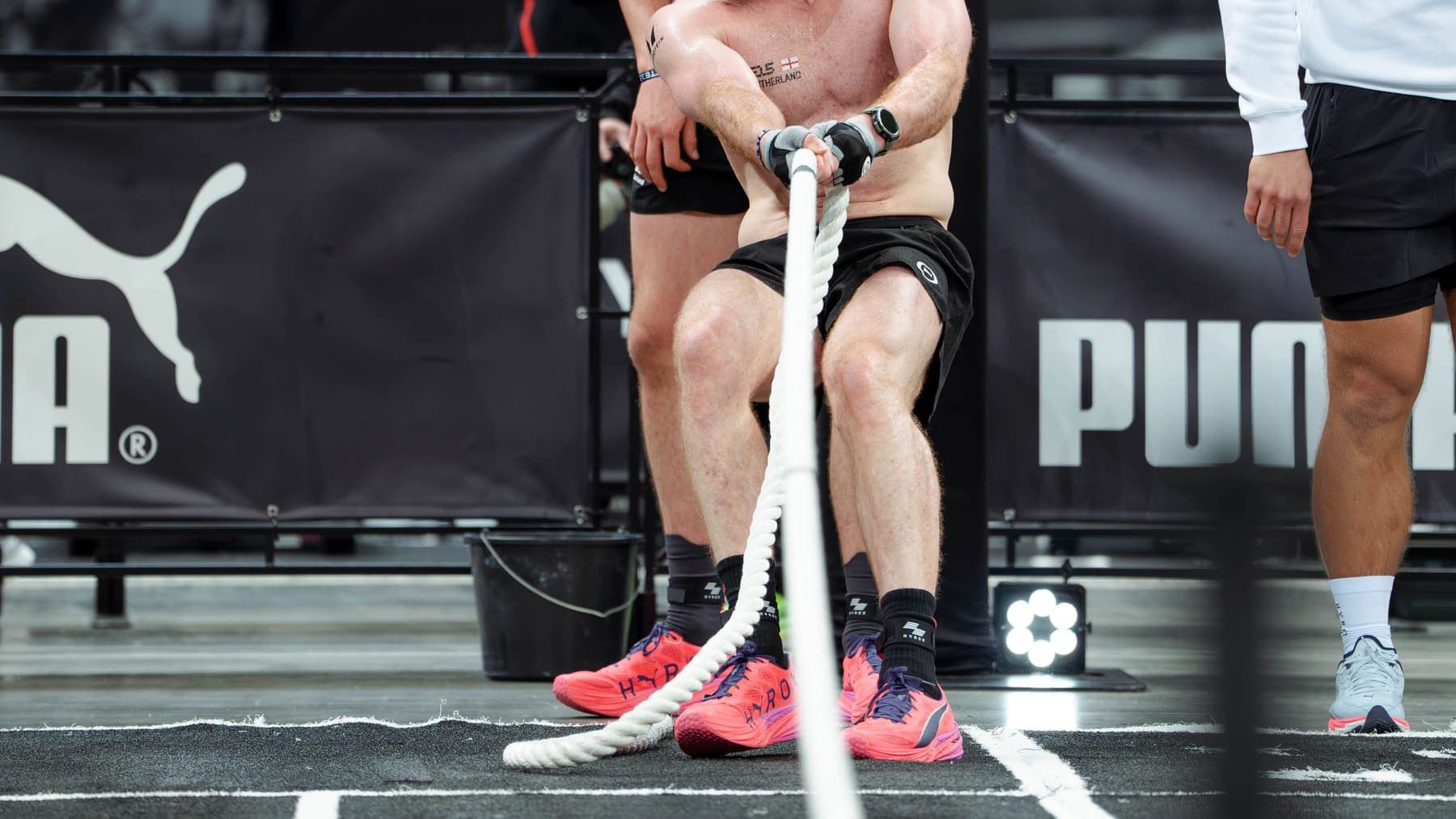
The sled pull is a station most athletes underestimate. The technique fixes that take 90 seconds off your time, in detail.
Technique
Hyrox sled push: technique, programming, and the mistakes that cost minutes
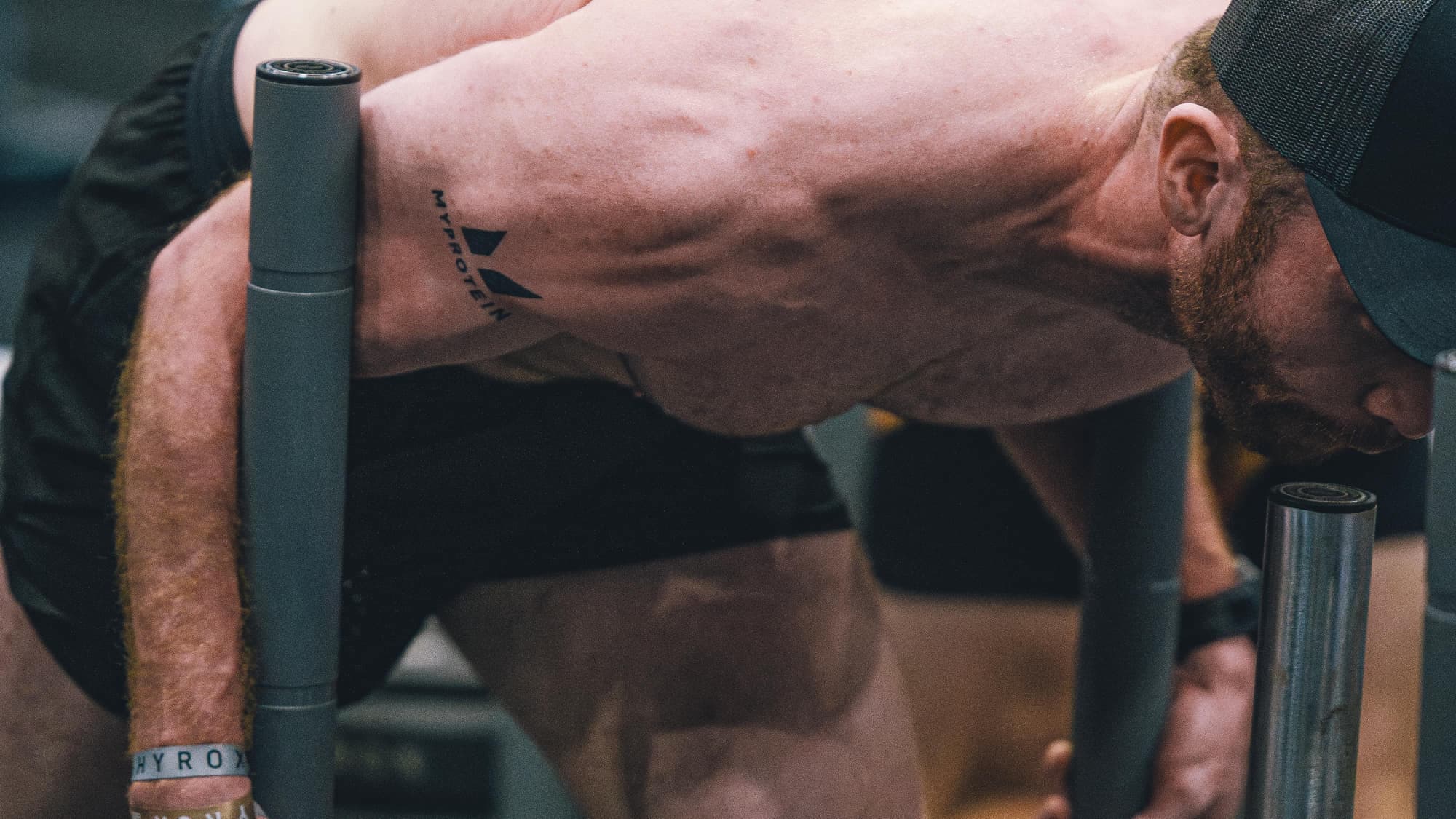
The sled push is where most first-timers lose two to four minutes. Body position, breathing, and pacing fixes that transfer to race day.
Technique
Hyrox wall balls: weight, technique, scaling, and the rep count that breaks people
The final station. 100 reps for men, 75 for women, after 7,000 metres of running and seven stations of work. How to make wall balls survivable.