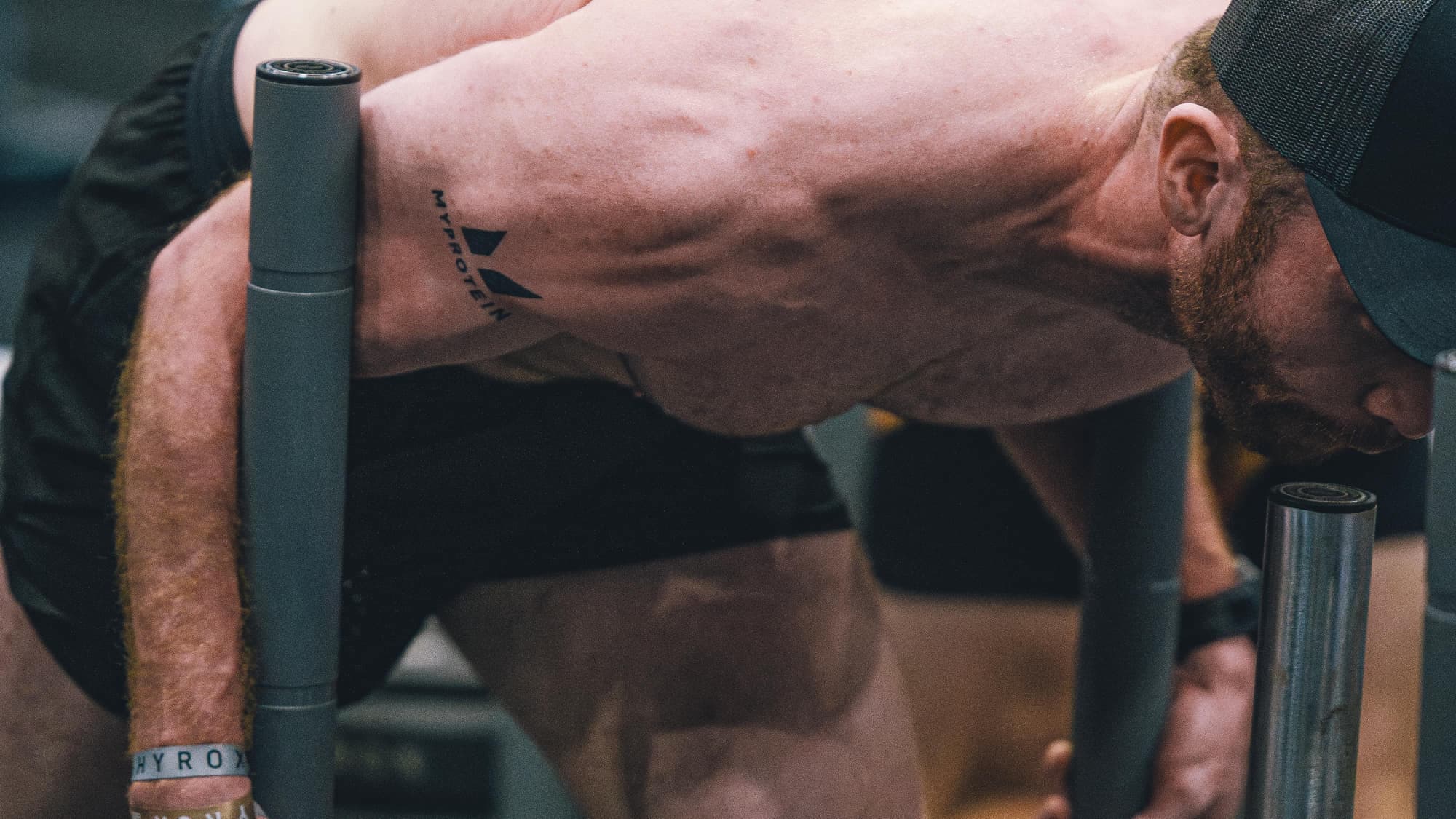
The Hyrox sled push is the one station that humbles strong athletes and rewards technicians. Forty kilograms separates a 90-second push from a 3-minute push. That delta isn't strength, it's body position, foot strike, breathing, and the willingness to stay low when your back tells you to stand up.
This is a station you can train your way out of. Most first-timers add 30-60 seconds of unnecessary time to their sled push because nobody told them how to do it properly.
What the sled actually demands
A Hyrox sled is heavy and stationary. To move it 25 metres, you need to overcome static friction once (the hardest single moment of the station), maintain forward force, and avoid stopping. Every stop resets static friction. A push with three stops takes longer than one continuous push, by a wide margin.
The forces involved: roughly your body weight horizontally per metre of travel. The work is high. The strength required is moderate. The technique is everything.
Body position: low, long, locked
Three positions that work:
1. Low body angle. Your torso wants to be 30-45 degrees from horizontal, closer to a sprinter's start than a runner's posture. The lower you are, the more horizontal force you produce per unit of leg drive. Stand tall and you push the sled into the floor; lean forward and you push it across the floor.
2. Long lever. Arms extended, locked at the elbow, hands gripping the upper section of the poles. Bent arms turn the push into an unstable bench press, you waste energy fighting your shoulders instead of driving with your legs.
3. Locked spine. Neutral, not rounded. The push is a leg-driven movement that uses your spine as a transmission line. A rounded spine leaks force and loads the lower back. Brace your core, look about a metre ahead of the sled, breathe.
If you watch elite Hyrox athletes push the sled, they look almost identical to each other: low, long, locked. That uniformity isn't coincidence. It's biomechanics.
The first three metres at 85%. Get it moving. Don't go all-in. The next 22 metres are easier if the start is composed.
Foot strike: short, fast, behind
The single most common technical error is taking long strides on the sled. Long strides put your foot ahead of your hips, which means you're trying to push off the back foot while standing on the front foot. The sled doesn't move because the force vector is wrong.
What works:
- Strides of 30-50 cm. Short. Like a tiny shuffle, not a stride.
- Foot lands underneath or slightly behind the hip. Toe down, ball of foot to forefoot strike.
- Hips drive forward continuously, not bobbing up and down. Imagine a string from your hip pulling forward.
If you're new to sled work, try this in your next training session: push 10 metres with your normal stride, then 10 metres with strides half the length. The shorter strides will feel slow but the sled will move faster. Counter-intuitive, then obvious.
Breathing: pattern, not gasping
The sled push is anaerobic work for most people. You'll feel oxygen debt by the 15-metre mark. Two breathing patterns that work:
1. Match the stride. One breath in over two strides, one breath out over two strides. Rhythmic. Predictable.
2. Brace and exhale through the hardest section. For first-timers, the first 10 metres are the hardest. Brace your core, exhale steadily through pursed lips. Don't hold your breath, that's a one-way ticket to going dizzy at metre 18.
The breathing pattern matters because the sled push is part of a 90-minute race. You're not pushing a one-rep maximum. You're pushing 25 metres at a sustainable effort and recovering from it on the next 1-km run.
Pacing: don't blow the legs
Sled push is station two. Wall balls is station eight. If you crush the sled at maximum effort, you'll arrive at wall balls with toast-legs and lose three times the time you saved on the sled.
The first-timer's sled-push pacing rule: target 80-85% of your maximum sustainable push effort, not 100%. You should finish the 25 metres breathing hard but composed, ready to run a controlled kilometre, not collapse against the wall.
A useful self-test in training: push the sled for the full 25 m at race weight. If you can immediately follow it with an 800-metre run under 4:30 pace, you paced the sled correctly. If you have to walk the first 100 metres of the run, you went too hard.
The training: how to get good at the sled when you don't have a sled
Most home and standard gyms don't have a Hyrox sled. You can still train the movement effectively:
Substitute 1. Heavy push-pull on a turf strip. Most commercial gyms have a Prowler or sled equivalent. Load it heavy. Aim for 4-6 sets of 20-30 metres with 90 seconds rest. Once a week.
Substitute 2. Heavy plate push on smooth flooring. Two 20-kg plates stacked, pushed with hands. Not a perfect simulation but the leg drive and body position are identical. 4 sets of 15-20 metres.
Substitute 3. Loaded carry with forward lean. Farmers carry the heaviest kettlebells you can hold for 30 seconds, with a deliberate 20-degree forward lean. Builds the bracing pattern.
Substitute 4. Sprint hill push pattern. Find a 6-10% incline. Sprint up it in short strides, leaning forward, for 15-20 metres. Walk down. Repeat 6-8 times. Closest free-equipment substitute.
Pair any of these with a 400-metre run immediately after, and you've built the sled-into-run transition that defines the race.
The mental model on race day
When you hit the sled lane on race day, the queue is busy, the music is loud, and the temptation is to attack the first three metres at maximum effort. Don't.
The pattern that works:
- Walk up to the sled. Don't sprint to it. The clock is running on the lane, not on your approach.
- Set position before you push. Hands on poles, feet shoulder-width, body low, brace.
- First three metres at 85%. Get it moving. Don't go all-in. The next 22 metres are easier if the start is composed.
- Find rhythm by metre 10. Short strides, regular breathing, eyes forward.
- Last 5 metres are the hardest. This is where your legs scream. Stay low. Don't stand up.
- Touchdown, transition, run. The moment the sled crosses the line, jog to the running gate. Don't sprint, don't walk. Jog.
If you nail this pattern, you'll save 30-90 seconds versus your first-attempt time. For a 100-minute race, that's meaningful.
What good looks like on the clock
For reference, by category:
| Category | Sled push target time | | --- | --- | | Men's open, first-timer | 60-90 s | | Men's open, sub-90 finisher | 45-60 s | | Women's open, first-timer | 50-80 s | | Women's open, sub-95 finisher | 35-50 s | | Doubles (each athlete) | 30-50 s per push |
If you're well outside these ranges, the fix is almost never strength, it's technique. Film yourself in training. Watch the angle of your torso, the length of your strides, and the position of your foot at strike. Compare to elite footage. The gap will be obvious.
[ WORKOUT DEMO ]
Sled push: race-pace setup
1:42
The sled is one of the few stations where a poor athlete can become an average athlete in two training sessions of focused work. Take the two sessions.
More on sled push
- The faults that cost time on sled push, and the rulebook standards behind them.
- Five sessions that build a faster sled push, with benchmarks to test progress.
- The sled push station page for the movement standard in full.
- Station order: what this station borrows, and where the bill arrives.
[ FAQ ]
Frequently asked
How heavy is the Hyrox sled?
152 kg for men's open, 102 kg for women's open. Doubles, pro, and masters categories have separate weights, check the official Hyrox standards for your category.
Why does the sled feel impossible at the start?
Static friction. A sled at rest needs more force than a sled in motion. The first metre is the hardest by a wide margin. Get it moving, and the rest is rhythm.
Should I take breaks during the sled push?
If you must. Better to break it into two clean efforts than to grind to a stop mid-lane. Best is one fluid effort, but for a first-timer, planned two-by-twelve-and-a-half-metre splits are honest.
Written by
The Suth Performance teamCoaches and editors
The Suth Performance programming team, led by HYROX Elite 15 athlete Ben Sutherland. They write the training, technique and race-day guides on this site, and Ben reviews every one before it is published.
[ KEEP READING ]
Related guides

Technique
Hyrox burpee broad jump: technique, breathing, and the rhythm that saves the back end
The burpee broad jump is where pacing goes to die. Twenty metres of compounding fatigue. The technique fixes, breathing pattern, and scaling options that protect the second half of your race.

Technique
Hyrox sandbag lunges: technique, breathing, and the 4-step recovery
The sandbag lunges look easy in training and ruin athletes on race day. The technique, the rhythm, and the recovery trick that saves your wall ball legs.

Technique
Hyrox sled pull technique: feet, hands, and the rhythm that wins
The sled pull is a station most athletes underestimate. The technique fixes that take 90 seconds off your time, in detail.